Twenty One

The following prose poem is from my book PLUM BLOSSOMS, an 81 poem narrative about the peregrinations through Japan of the banished Zen monk Master Ko

a path through woods banked in drifts, glazed, up the hillside as the snow covered red tile roof comes and goes, skewed by green snow laden limbs

with the dim light of the back dock leading them on

stomping feet up shoveled steps,

dog barks and a portly balding man says well well well, so you have come back

so i have, says master ko

i do beg your pardon, sir, i spoke to the dog

yet here i am, says master ko, and you, too, professor, here you are

dog barks up at one and again at the other

you have me at a disadvantage, says the professor

many students, one professor, says master ko

ah, so it is

you have exchanged the lecture hall for the refectory, philosophy for recipes

so i have, so i have; less, i find, is more, nothingness is the kernel of the infinite

dog nudges master ko’s hand, but the abstruse remains

a look, then: so who is this fellow, dawg, that you have brought to my door, asks the professor, and invites them in for oatmeal and eggs

and so,  as the morning wears, in come women, sprightly or stooped,  who pad quietly in to eat and go

with rosy cheeked children well in tow

and old men with knobby red knuckles and broken nails, the frail veined hands cradling

chipped cups large and small of blue and black and red and yellow while

fuzzy headed novices scurry about swabbing tables and sweeping floors

oatmeal and eggs and white plastic spoons with

the lopeared mongrel asleep in the pantry, muzzle upon 

his crisscrossed paws

ladling thick cooked oats into offered bowls

gapped tooth grin

belly full

slapping a knee

THE COAST ROAD

Between Pacific City on the Oregon coast and the Cape Meares lighthouse to the north is a narrow two lane blacktop road that serves both the locals and the tourists—the dairymen and the fishermen, the hiker and the bicyclist—by providing access to land and sea. At the same time, the road serves by giving definition to the land, a physical definition through its function as a line that takes the measure of the terrain as the lines on a contour map do, now rising, now falling, here looping, there straightening; and a transcendental definition through its function as a poetical metaphor that takes the measure of this geography as a poem takes the measure of an idea or theme.

The poem uses the collision of words, the separation of phrases, to express itself. The road finds its expression in the brown cows ruminating cud, in the rusted jetsam that once was truck, in the solitary chimney standing sentinel over the blackened rubble that once was house, in the red barn, the sand dunes and mats of salal, the towns of ramshackle and renovated that punctuate the road, in the estates of chime and glass, cottages with frayed lace curtains and unkempt lawns, the bright green rectangle of new laid turf, the stumps and deadfall littering clear-cut hillsides, the mongrel yapping at the end of its chain, a rock slide, a bent and twisted guardrail, the missing sign, the rock and sand, and, finally, in the lighthouse, barely visible through the evergreens, a revolving blip of light out on some final point of land that measures the waves steady thump and rumble.

There is something elusive about this stretch of pavement, an ambiguity, a question hovering like the fog that is so ever-present hereabouts. There is meaning beyond the sum of its parts, beyond form and meter, beyond linguistics, beyond theme. So, too, do the many parts of the road scene, all the constituents along this strip, seem to speak more eloquently when conjoined than when examined individually. And, just as a poem only finds its voice after assembly, so it is along the road. There comes a grace to the man slopping his sow against the backdrop of the distant headland, a heroism to the lone chimney lost in the expanse of field and dune, a tender emotion, a moving presence, to that archetypal American family—mother, father, brother, sister—in matching shirts and shorts with their station wagon and dog down for a day at the beach.

Meaning is often incommunicable, beneath the surface, defying elucidation. Words hint at meaning; but often meaning can only be experienced. Abstraction is elusive; substance is not. The traveler suspects some hidden meaning lurking beneath the surface value of asphalt, house, widow, business, land form, grocer, seascape, and lighthouse, feels a need for explication. But unless he pauses in his travels, suspends his journey and noses about turning stones, that suspicion will rise on a sea breeze and be gone, the traveler none the poorer, but none the wiser either.

Pause, suspension, waiting, sitting quietly are keys to scanning this road. Everyone hereabouts lives in three-quarter time, and this waltz tempo helps define the area. By contrast, Highway 101, running a few miles inland, is an upbeat four-four proposition. Travelers propelled along by destination, by assignation, would not likely choose the coast road for their journey. The hard traffic stays on the 101. It is the quick link between Lincoln City and Tillamook. Cape Meares, Oceanside, Netarts, Cape Lookout, Sand City, Tierra del Mar, Kiwanda, and Pacific City are out-of-the-way places. Log trucks will vie for space on the 101; large, loud, and aggressive, they are no bargain. The odd truck plying the coast road gives some ground, like as not, perhaps a wave of the hand, not smiling, not friendly mind you, but not contentious either.

Businessmen on the 101 push their machines with abandon. The retiree in his motor home, seeking some refuge for the refuge he is driving, seeking some glimpse of the Pacific, some sound of the gulls, will be found pulled off in a turnout, nose to map, perplexed, dismayed. He is on the 101, after all, with little quarter given.

The coast road is the other road the retiree seeks where stopping on a whim becomes the attractive alternative, and experience finds opportunity to wander from the objective to the subjective, from destination to journey, from denotation to connotation, from white line of highway to white line of breakers.

Along this coast road the traveler is rarely far from the pounding surf. It is not a place to be in a rush; there is time here, but not seconds and minutes nor even hours. There is morning, afternoon, evening, and night. There are weeks and months and years. See it in the ramshackle building, some collection of homespun architecture nailed together over decades, the pumps still out front marking it as a gas station of a by-gone era. Out back are the odds and ends of automobiles, disarrayed like children’s toys after a morning’s play, hoods askew, wheels and doors gone, windshields shattered.

Attached to the building’s flank, a rusted metal stack pokes above the roof line and smoke curls gently up and away. The door dings open, the traveler waiting at the pumps. Out ambles a boy with a ball cap pushed back on his head, dungarees oil stained, the suit short-legged, hand-me-downs, his hands stuffed deep into his pockets. Has he just wakened?

The traveler asks for gas and for the distance yet to Pacific City. The boy, imitating the father who is from Kansas, says, “Three mile.” He spits, like the father, then turns slowly away to the sound of an old dump truck rapping in deceleration down the hill, hauling gravel.

Boy and driver exchange nods, pumps gas absently. The tank full, the boy milks the pump, adding pennies, then done. “Eight dollar fifty cent,” says the boy to the traveler. The look might be called vacant, but his youth keeps it just this side of blank, an imitation again of the father whose eyes are long absent, doing the same thing over and over again, eking out a living here on the coast road, a fair life, the father says, quiet like, can’t complain none, wife’d like the city some, spitting, pumping gas, telling the tourists time and again, three mile, knowing that soon enough those city people on their fancy bicycles will start coming through, never buying nothing, bottle of water maybe, or them Powerbars he’d been stocking, just wanting to use the can, telling them, nope, broke, which it ain’t but he just don’t cotton to giving things away.

This is the rhythm, the pace of life, on the coast road. If there is a rush, a hurry, best turn right at the junction and head her over to the 101.

All the varied entities that the traveler meets along the way—the beach cottages, the dilapidated sheds, a pair of horses standing head to tail, a grain elevator, hay ricks, sties, skunk cabbage, creek, the gathering wave—constitute the words and phrases of the road. The bay collides with the headland and a gentle mist rises. The rhymes here are less aural than visual: The martin winging against the pale dawn sky gives flight to black and white cows scratching at fence posts; an old man profiled at the end of the jetty fishing is mirrored by the snag hanging leafless over a swift creek.

Equally varied are the themes, the motifs, of the coast road. Central to the road, both physically and metaphorically, are the sand dunes that lie between the Kiwanda headland and Cape Lookout. All along the road through these dunes are signs warning of the soil stabilization project, prohibiting motor vehicles. The loops and swirls, the tread marks across the flats and through gullies give testimony to the effectiveness of the deterrent.

The traveler feels a tension here. This is the arena where the road’s two protagonists, man and nature, do battle. A State Park ranger, who officiates at the fray, occupies the foreground as the traveler approaches. The ranger nods curtly, then turns away from the traveler to continue his note taking, keeping score.

The sand, covering many square miles, is a most fragile environment. Though only the two lanes of blacktop cut it, the advantage in the short-term seems clearly with man. Thinly treed, matted with salal and grass, the dunes provide habitat and forage for rabbit and frog and snake, hoppers and sliders. Here man plods across the soft ground, trips in the tangled weed, starts at the sudden leap of gray-green, black-eyed frog. Overhead a red-tail hawk circles, hunting. A moth the color of weathered cedar ignores the curse of the man and floats and dips and flutters.

Resentful at his immobility, man brings his machines, though clearly this is no place for motor and wheels. This is a wild land, as-it-was land, save for the signs and the two lane blacktop bisecting. Man comes with his machines, becomes the ultimate predator, preying on the land itself. The ensuing destruction is rapid and all encompassing; but here, unlike the hillside on which the devastating effect of clear-cutting is readily apparent, it is difficult to see man’s impact.

“It’s just sand for Christ sake,” says the ATV enthusiast.

Only the geologist, the biologist, the botanist, the entomologist can truly take its measure. And then post signs. All the same, a frog meeting with an all-terrain vehicle faces the same odds as does the bicyclist who strays into the path of a log truck out on the 101.

At the end of this particular stretch of pavement comes, finally, the lighthouse. This seafarer’s beacon warns of the treachery of rock and tide, illuminating darkness, piercing fog. It was not supposed to be on this point of land; it was supposed to have been built on Cape Lookout, some miles to the south. All the building material, however, got delivered to the Cape Meares site; and, with no coast road here in 1890, with access so difficult, so dangerous, the lighthouse rose where the materials dictated, the harsh terrain having the final say.

That seems fitting, thinks the traveler, watching the light go round. Man proposes; the earth disposes. Not in the short-term, of course; for in time even this lighthouse will be gone. For the moment, the beacon seems an appropriate response to the question raised by the coast road. Here is the best of 19th century engineering wedded to the land, functional, beautiful. This marriage of science and humanity provides the elusive quality that rises like the fog all along this stretch of pavement, this sinuous man-made track through nature’s glories. Like an alchemist’s dream, there is a balance, a blending of the ingredients that defies addition. Here the metaphor of the coast road manifests itself.

The traveler trains his eye on the far horizon: The endless sea. The light goes round. Seagulls cry. Chilled by the stiff breeze, the traveler steps through the door at the base of the lighthouse and begins his upward spiral.
THE OLD WAYS, A Remembrance of Everett Darr

Darr’s Mountain Shop was three stories high and  sided with rock. The gneiss blocks sat a bit proud of their mortar making for a good climb to change the light bulbs up under the eaves that illuminated Darr’s Mountain Shop. Everett Darr had been, in his day, a solid performer on rock, snow, and ice. He feigned disinterest or annoyance at my buildering solos, but there was a twinkle in the old man’s eye.

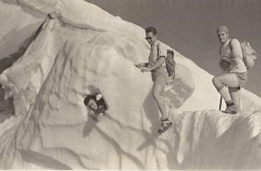
On Mt Hood’s Eliot Glacier: (R-L) Darr, Mount, and Calkin, 1930s. (Photograph courtesy of Gary Randall Photography.)

By then, this early spring of 1978, all that remained for Everett of climbing and skiing were remembrance and tall tales. Bone breaking falls and old age had made his joints arthritic, his walk a shuffle. Nothing, however,  had diminished his spirit.

Tough as an old boot is a cliché, but Darr was; he would give a man nothing that was not earned, neither wages nor respect. Some disliked his gruff manner; others accepted him as he was. Some thought his stories a bit too tall, but the man’s record speaks for itself.

Washington’s North Cascades saw Everett and wife, Ida, make numerous pioneering efforts on peaks that were, in the 1930s, all but inaccessible . Mt Hood, on the other hand, was in his backyard. Darr, with Jim Mount, put up a first ascent of what became the Wy’East Route on Mt Hood. In 1940,  he added another first ascent, this time of St Peter’s Dome in the Columbia River Gorge again with Ida, Joe Leuthold, and Jim Mount.

But those days were gone now. Only the memories endured.

Down in the basement of the Mountain Shop where the rental skis were kept, time passed slowly on rainy winter afternoons. Everett would always stop by and tell a tale. He never mentioned his triumphs, only the hard times. The grey skies reminded him of a night in the North Cascades after an attempt on Mt Goode. He and Leuthold were caught out by darkness, wind, and rain. They crouched in a tree well with nothing but the clothes on their backs. Leuthold rummaged in his pack. Extracted a bottle of whiskey. They drank to their two left feet and cowardly retreat.

Another day in early spring on Mt Hood: weather coming down with the darkness. He, Ida, and Joe, skiing this time out, came to a steep pitch laden with snow—it might have been Newton Clark glacier, or Eliot, or Coe. Everett did not always have the names quite right; but if all the facts were not straight, that was just too bad. The listener always knew he had been there, and usually before anybody else.

That steep pitch they faced had stopped them. Below, the crevasses had begun to gape open. A fall would be a dangerous occupation. They had traveled light, as usual, and a bivouac was not an option. Leuthold did have a length of rope. He offered a belay. Everett gallantly deferred to the lady. Ida roped up, poled off gingerly, turned slightly downhill for a bit of speed and just then a slab cracked and sloughed off beneath her. Down she went, flailing to stay on the surface of the slide.The rope went taut, and held. The avalanche rumbled off down the mountain. Everett hooted to salute his wife’s survival and skied quickly across the firm slide path.

One storm bound day in the basement of the shop—the snow had just slid off the roof three stories overhead and had effectively destroyed a Volkswagen parked too near the building—Everett leaned against the mounting bench and regaled me with an account of storm climbing. The middle of January had finally delivered some nasty weather. He and the usual suspects spent the night in the old Timberline cabin on the Palmer snowfield. By dawn they were off. Through wind driven snow they plugged up the snowfield.

Reaching what they determined to be the Triangular Moraine, a pow-wow was called. Conditions were, well, marginal. Wet and cold, they decided to climb on. Through the morning hours, the winds subsided, the snowfall became intermittent. Someone suggested they have some lunch and wait for the weather to worsen.

But up they went. As the day waned, the storm returned with a vengeance. Voices were lost in the wind and snow. They communicated with tugs of the rope. As Darr—or Calkins or Mount or Leuthold—crested the Hogsback, the wind tore at him. Up he went, a sack of bones and flesh in flight, picked up and tossed in a bundle down slope.

They huddled together. Great sport, they all agreed; but the day was gone, so down they went. Darkness had caught them, but it didn’t matter. They had not been able to see anything for hours anyway. Skill or luck or just plain orneriness saw them back to the cabin.

Looking north from Leuthold’s Couloir, photograph by the author, December 1981, with the Columbia River beneath the line of cloud and, in the background, Mt St Helens and Mt Adams.

One dismal spring day with rain and sleet, I waited as I heard Everett coming down the stairs, one step at a time. It took awhile. He stopped at the bottom of the stairs and looked around the corner into the shop. Outside, ravens commenced squawking.

“You got my hat?” Everett says to me.

“No, Everett,” I say. “I surely don’t.”

“Why not,” he snaps

I raise my eyebrows.

Everett shakes his head, puts on a sour face. He looked back up that long flight of stairs. He had remembered where his hat was.

Suddenly, he grinned, an elfish smile. “Damn steep stairs, ” he says. “How about roping me up? Awful steep. How about a belay?”

And then he turned, took a good hold on the rail, and up he went, one step at a time, up he went.

THE ANCIENT RIVER

The following is an excerpt from my book A BRIEF HISTORY OF THE COLUMBIA RIVER. The book is available at The Book Patch Bookstore and at Kobo eBooks.

WE STRUGGLE WITH numbers we cannot imagine. 100,000 people fill a football stadium and gives us some notion of this number; but a million years leaves a blank. Geology seems rife with such numbers. 4 billion years ago the planet came to be. 62 million years ago came the extinction of the dinosaurs. Several million years ago, with the exception of the Columbia River Gorge and the river that runs through that gorge, the Pacific Northwest looked much as it does today. Glaciers would come, and glaciers would go, covering and carving the landscape. Mountains were pushed up and ground down. Volcanic eruptions, rising and falling sea, wind and rain all added their signature.

Mouth of Columbia River Gorge. Mitch Williams’ photo.

Before the river there was lava. Before the mountains there was lava. 17 million years ago the  first eruptions were a series of immense lava floods flowing from great fissures near the present Oregon-Idaho-Washington border. Some of these flows, among the largest ever to occur on Earth, traveled as far as 400 miles from their eastern vents to Yaquina Bay on the central Oregon coast. Individual flows covered as much as 10,000 square miles, equivalent to one tenth of the state, and many are over 100 feet thick. Columbia River Basalt, exposed in many places through the gorge, often cooled to form the distinctive basaltic  columns that have become an iconic part of Oregon’s scenery.

Over millions of years, deposits of clay, sand, and gravel left by inland seas, lakes, and rivers were layered within the lava flows forming distinctive strata. Over time these deposits were compacted into soft rock, then lifted and tilted by tectonic forces. Mesas and mountains rose and were eroded away only to rise again, shaped into hills and buttes and mountain peaks by weather, wind, and water

Three to five million years ago came the evolution of the five salmon species known today. Fossils unearthed in ancient sediment show that giant sloths, porcupines, horses, and a host of other creatures great and small, existed.  And during this same time, an epoch that geologists label Pliocene, the river began to carve its path south and west to the sea.

Volcanoes, then, made the creation of the Columbia River possible. A geologist might quibble. Technically, the bulk of the lava flowed from linear fissures. Eruptions like Mt St Helens (1980), are fairly recent. Mt Hood last erupted in 1781. Even Mt Mazama is dated at just 30,000 years ago, an eye blink geologically. The lava floods were much older, and had a far greater impact. The lava, however generated, provided the ground and the parameters which determined the river’s path, its width, its depth.

By 3 million years ago, the river had begun its work carving a course through the recurring uplifts and volcanic outflows. A million years ago, the Columbia’s path was much like it is now. 20,000 years ago, the river had carved a deep V-shaped channel through the basalt flows, the sand and gravel, the mud and clay, cutting a course from the rolling Palouse of eastern Washington, across the arid uplands of eastern Oregon, through the Cascades, and on to the coast. The ancient river’s banks rose abruptly up to mesas in the east, then to the higher peaks through the Cascades; finally, as the river met the valley and slowed, it widened and gently flowed to its meeting with Pacific tides.

No evidence of a native people exists for this early period in the river’s history. Some archaeologists working with anthropologists think a date of 20,000 years ago is quite possible. The Pleistocene’s last ice age still held most of the northern half of the continent  in its grip, and the climate was 6 – 8 degrees colder. South of Puget Sound, however, the land was free of ice and did offer habitation and a bounty of fish, game, and plants.

If native people did inhabit the region 20,000 years ago, those living along the river were in for an unpleasant surprise. The gradual warming of the planet that ended the age of ice began 16,000 to 19,000 years ago. This warming caused the erosion of an ice dam in western Montana. That dam held back a body of water nearly the size of Lake Erie. The precipitous collapse of the ice and the sudden release of such a large body of water that inexorably followed created unimaginable floods.

A wall of water a thousand feet high moving at 50 miles an hour would have created an air blast heard a half hour down river. Chaos and catastrophe followed. Flood waters 400 feet deep inundated what is now Portland. The Willamette Valley was flooded as far south as Eugene. Little wonder that no evidence of inhabitation can be found along the river’s banks.

Named the Bretz Floods (or Missoula Floods or Spokane Floods) for Harlan Bretz, the geologist who first proposed the idea of cataclysmic flooding, the water once released from its impoundment followed the Columbia’s channel through the scablands of eastern Washington, the mountains of Oregon, and out into the Pacific transforming everything in its path. Flood waters scoured the excellent top soil of eastern Washington and deposited most of it west of the mountains, much of it down the Willamette Valley. The ancient V-shaped river valley was scooped and dredged by the rush of water, ice and stone; and the U-shaped gorge we see today resulted. This, too, was the river that Lewis and Clark saw.

Wallula Gap marked the turning point for the Bretz floods. Twin Sisters Rock, southeast of the gap, offers a sweeping view of the river and the narrow cut in the basalt plateau which provides the only outlet for the entire Columbia Basin of eastern Washington. The immense volume of water quickly filled this inadequate passage, and rose to cover the high hills to the east and south and Horse Heaven Hills to the northwest.  The flood waters, balked as they were, inundated the region as far north as Ephrata, over 100 miles away, with water deep enough to form the short-lived so-called Lewis Lake.

Twin Sisters Butte

From a book written in 1920 by L.R. Freeman comes this description of Wallula Gap and Twin Sisters:

A skyline of brown mountains, with a double-turreted butte as their most conspicuous feature, marks the point where the Columbia finally turns west for its assault on the Cascades and plunged to the Pacific. That bend is the boundary of the fertile plains extending from the Yakima to the Walla Walla, and the beginning of a new series of gorges, in some respects the grandest of all. The matchless panorama of the Cascade gorges is a fitting finale to the stupendous scenic pageant that has been staged all the way from the glacial sources of the Columbia.

The double-topped butte, an outstanding landmark for voyageurs for a hundred years, has long been called “The Two Virgins.” The story is told locally of a Catholic priest who saved his life by taking refuge in a cave between the castellated turrets during an Indian massacre, but who got in rather serious trouble with the Church afterwards as a consequence of sending words of his deliverance by a French-Canadian half-breed voyageur. The latter got the salient details of the story straight, but neglected to explain that the two virgins were mountains. The result was that the unlucky priest narrowly missed excommunication for saving his life at the expense of breaking his vows. I got no affidavit with the story, but local “stock” yarns are always worth preserving on account of their color.

A legend of the Cayuse tribe who lived in that area  tells a different tale of the butte’s creation. Coyote—the mythical reprobate of native lore—had become enamored with three  rather lovely sisters who chose to remain aloof. Unrequited, jealous, he turned one of these young women into a cave, and the other two into the prominent rocks on the Washington shore. 

The formation has been given many names over the years: Two Captains (for Lewis and Clark), Chimney Rocks, Hell’s Smokestacks, Cayuse Sisters, and the Twin Virgins.

The two pillars attest to the strength and fury of the Bretz Floods. Once part of the extensive Columbia Basin lava field, the flooding stripped away the looser sediment and left the Twin Sisters. As the waters subsided, the pillars emerged to become today’s prominent landmark.