SAGACITY

We are sitting on the rocks by the river waiting and watching as three ospreys circle overhead, hunting. The snow in the mountains has gone with the latest batch of hot weather; the river is low and, to our eyes, fish are scarce. What the ospreys see is, of course, something else again. Our vision is quite good. Some biologists think that our large brain became necessary to process all the perceptions our eyes (and other senses) take in, that our brain size has evolved more specifically with our visual acuity. Ospreys, apparently, can see twice as well as humans. However, that generalization does not tell the whole story: Osprey have the largest eyes relative to size of any animal; they have four color receptors to our three and can see ultraviolet light; their visual acuity due to a denser number of receptors is much better than ours; they can perceive the refractive index and so adjust their angle of vision to see beneath water’s surface; and ospreys can perceive magnetic fields to aid in navigation. Just how they process all this information  is unknown and, arguably, unknowable.
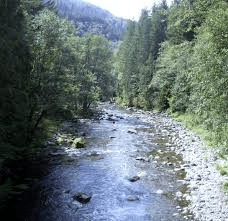
Salmon River near Mt Hood

Humans, according to a Caltech paper, think at a rate of 10 bits (binary digits) per second. However, our bodies’ sensory systems gather data about our environments at a rate of a billion bits per second, which is 100 million times faster than our thought processes. We are slow thinkers; and often cannot see the forest for the trees.

In 1890, concerning the notions of perception, conceptualization and, in turn, sagacity, William James wrote:

All our knowledge at first is vague. When we say that a thing is vague, we mean that it has no subdivisions ab intra , nor precise limitations ab extra ; but still all the forms of thought may apply to it. It may have unity, reality, externality, extent, and what not — thinghood , in a word, but [p. 344] thinghood only as a whole.  In this vague way, probably, does the room appear to the babe who first begins to be conscious of it as something other than his moving nurse. It has no subdivisions in his mind, unless, perhaps, the window is able to attract his separate notice. In this vague way, certainly, does every entirely new experience appear to the adult. A library, a museum, a machine-shop, are mere confused wholes to the uninstructed, but the machinist, the antiquary, and the bookworm perhaps hardly notice the whole at all, so eager are they to pounce upon the details. Familiarity has in them bred discrimination. Such vague terms as ‘grass,’ ‘mould,’ and ‘meat’ do not exist for the botanist or the anatomist. They know too much about grasses, moulds, and muscles. A certain person said to Charles Kingsley, who was showing him the dissection of a caterpillar, with its exquisite viscera, “Why, thought it was nothing but skin and squash!” A layman present at a shipwreck, a battle, or a fire is helpless. Discrimination has been so little awakened in him by experience that his consciousness leaves no single point of the complex situation accented aud [sic] standing out for him to begin to act upon. But the sailor, the fireman, and the general know directly at what corner to take up the business. They ‘see into the situation –that is, they analyze it — with their first glance. It is full of delicately differenced ingredients which their education has little by little brought to their consciousness, but of which the novice gains no clear idea.

He, of course, had a good deal more to say, as he always did, but that should suffice. He did put humans at the top of the list for sagacity. Brutes occupied the lower reaches. I beg to differ. I suggest that our vaunted ability to think and reason and speak is less a blessing and more a curse. The current state of the planet makes, I think, a good argument for this position.

Homo sapiens? Guess again.

If James’ opinion of ‘brutes’ is flawed, questions arise: Just how perceptive are brutes? And what exactly did he have in mind with that word? Whales perhaps? Or wolves? Or ravens; and how well do they communicate? how well are they integrated into their environments? Amphibians have existed for over 300 million years. Clever little devils. And just how intelligent might an osprey be? Are they, too, slow thinkers? Their hunts are successful only 25% of the time. Does this suggest a sluggish intellect? If pushed to an opinion, I would guess that all wild creatures perceive and process more efficiently than do humans. No living organism that I know of is at odds with its environment except human beings. The wonder might be that ospreys (and other wild creatures) survive as well as they do.

The birds seemed to have called it a day or merely have left the Salmon River for the nearby Sandy River. The Sandy is a bigger affair with more opportunities for a meal. All they need is several small fish or one larger one and they are replete (400 grams, it is thought). Perhaps the heat has sent them back to the nest. Are birds affected by heat? Birds are warm blooded and can regulate heat, so perhaps they have gone off to sit on a high limb in the shade. Whatever the case, even though they don’t stay long. It is always nice of them to drop by.

The sky is made a better place for the clear, sharp whistle calls of the fish hawks.

The temperature has reached 91° in the shade and it is not yet noon. Though the birds have abandoned the hunt, I am loath to leave the river. The wife has gone on to the post office and I’ll wait for her return. A dipper flits past, lands on a rock downstream and dives for a morsel. Of course, it may just be taking a quick dip to cool down. Robins, thrushes, jays all do the same. Our ponds are popular for bathing as well as drinking. Birds do seem to pant, but it is a different operation than how a dog pants. Birds can flutter their throat and cool in this manner.

I have worked up a sweat walking the quarter mile back to the house. No mail today. The wife has left me to check on a friend. Coming up our driveway, I take in the house. Two sides of the house are painted; the rest will have to wait for a break in the weather. Paint was drying on the brush faster than it could be applied. My wife, ever persistent, worked through two mornings and one early afternoon to get half the job done. 

I am concentrating on sanding and restaining our decks. The sanding does not begin until 9 AM out of consideration for the neighbors (and the hope that they will reciprocate). A two hour window in the morning cool has got me a quarter of the way through the job. Sitting by the river seemed a better occupation this morning, so I let the decks be.

A tomato and onion sandwich with a dab of Dijon mustard filled my belly, and a glass of ice tea and orange juice quenched my thirst. During lunch I listened to a few songs from Watchhouse and reflected on an interview with Emily Frantz and Andrew Marlin that I had seen recently. Our perceptions always affect us  on some personal level. Often we bite our tongues rather than speak and expose ourselves. Andrew, one of the best singer songwriters on the planet, was concerned about the rather personal nature of many of the songs on their new album. Then it occurred to him that everyone hears the song differently, and everyone makes it personal for themselves. The more empathy involved the closer one might come to someone else’s personal insights and emotions. But they then become our own, and the songs more often expose the listener’s emotions rather than the singer’s.

Many ‘brutes’ affect us the same way as do songs. Dogs and horses both have strong affinities with humans. Can we empathize with other critters? Those who work with animals would no doubt answer in the affirmative. Jane Goodall, for example, must have had some feeling and understanding for her apes. And Roger Payne must have felt privileged listening to and interacting with his whales.

Our friends know that they are welcome to drop by anytime, and many do. Most think there is a certain magic about our little piece of ground. We think it is simply a spirit of inclusion that we bring to the place. Spiders, newts, snakes, squirrels, ravens, skinks, raccoons, the odd black bear and the occasional osprey are all welcome. More directly, my wife and I have shared the place with over a dozen canine friends, mostly collies. An assorted group of cats also have roamed the place. And, not least in importance, we are surrounded by firs and cedars, a few hemlocks, some maples, cottonwoods and alders.

Brute has come to mean a savage and violent person or animal. For James in the 19th century, the word was more simply defined as an animal as opposed to a human being, an animal specifically lacking in intelligence. If we removed our opposition, we might all be considered brutes. When all is done and dusted, we are all animals, all part of the natural world, all interdependent.

Familiarity will breed discrimination, not for segregating, but for understanding; and with understanding comes both empathy and, most importantly, inclusion.

Thoth Hermes Trismegistus was, for the Egyptians, the god of wisdom, letters, and time. He had the body of a man and head of an ibis.

William James, Principles of Psychology, Vol. II; Dover Publications, New York.1890, p343.
THE COAST ROAD

Between Pacific City on the Oregon coast and the Cape Meares lighthouse to the north is a narrow two lane blacktop road that serves both the locals and the tourists—the dairymen and the fishermen, the hiker and the bicyclist—by providing access to land and sea. At the same time, the road serves by giving definition to the land, a physical definition through its function as a line that takes the measure of the terrain as the lines on a contour map do, now rising, now falling, here looping, there straightening; and a transcendental definition through its function as a poetical metaphor that takes the measure of this geography as a poem takes the measure of an idea or theme.

The poem uses the collision of words, the separation of phrases, to express itself. The road finds its expression in the brown cows ruminating cud, in the rusted jetsam that once was truck, in the solitary chimney standing sentinel over the blackened rubble that once was house, in the red barn, the sand dunes and mats of salal, the towns of ramshackle and renovated that punctuate the road, in the estates of chime and glass, cottages with frayed lace curtains and unkempt lawns, the bright green rectangle of new laid turf, the stumps and deadfall littering clear-cut hillsides, the mongrel yapping at the end of its chain, a rock slide, a bent and twisted guardrail, the missing sign, the rock and sand, and, finally, in the lighthouse, barely visible through the evergreens, a revolving blip of light out on some final point of land that measures the waves steady thump and rumble.

There is something elusive about this stretch of pavement, an ambiguity, a question hovering like the fog that is so ever-present hereabouts. There is meaning beyond the sum of its parts, beyond form and meter, beyond linguistics, beyond theme. So, too, do the many parts of the road scene, all the constituents along this strip, seem to speak more eloquently when conjoined than when examined individually. And, just as a poem only finds its voice after assembly, so it is along the road. There comes a grace to the man slopping his sow against the backdrop of the distant headland, a heroism to the lone chimney lost in the expanse of field and dune, a tender emotion, a moving presence, to that archetypal American family—mother, father, brother, sister—in matching shirts and shorts with their station wagon and dog down for a day at the beach.

Meaning is often incommunicable, beneath the surface, defying elucidation. Words hint at meaning; but often meaning can only be experienced. Abstraction is elusive; substance is not. The traveler suspects some hidden meaning lurking beneath the surface value of asphalt, house, widow, business, land form, grocer, seascape, and lighthouse, feels a need for explication. But unless he pauses in his travels, suspends his journey and noses about turning stones, that suspicion will rise on a sea breeze and be gone, the traveler none the poorer, but none the wiser either.

Pause, suspension, waiting, sitting quietly are keys to scanning this road. Everyone hereabouts lives in three-quarter time, and this waltz tempo helps define the area. By contrast, Highway 101, running a few miles inland, is an upbeat four-four proposition. Travelers propelled along by destination, by assignation, would not likely choose the coast road for their journey. The hard traffic stays on the 101. It is the quick link between Lincoln City and Tillamook. Cape Meares, Oceanside, Netarts, Cape Lookout, Sand City, Tierra del Mar, Kiwanda, and Pacific City are out-of-the-way places. Log trucks will vie for space on the 101; large, loud, and aggressive, they are no bargain. The odd truck plying the coast road gives some ground, like as not, perhaps a wave of the hand, not smiling, not friendly mind you, but not contentious either.

Businessmen on the 101 push their machines with abandon. The retiree in his motor home, seeking some refuge for the refuge he is driving, seeking some glimpse of the Pacific, some sound of the gulls, will be found pulled off in a turnout, nose to map, perplexed, dismayed. He is on the 101, after all, with little quarter given.

The coast road is the other road the retiree seeks where stopping on a whim becomes the attractive alternative, and experience finds opportunity to wander from the objective to the subjective, from destination to journey, from denotation to connotation, from white line of highway to white line of breakers.

Along this coast road the traveler is rarely far from the pounding surf. It is not a place to be in a rush; there is time here, but not seconds and minutes nor even hours. There is morning, afternoon, evening, and night. There are weeks and months and years. See it in the ramshackle building, some collection of homespun architecture nailed together over decades, the pumps still out front marking it as a gas station of a by-gone era. Out back are the odds and ends of automobiles, disarrayed like children’s toys after a morning’s play, hoods askew, wheels and doors gone, windshields shattered.

Attached to the building’s flank, a rusted metal stack pokes above the roof line and smoke curls gently up and away. The door dings open, the traveler waiting at the pumps. Out ambles a boy with a ball cap pushed back on his head, dungarees oil stained, the suit short-legged, hand-me-downs, his hands stuffed deep into his pockets. Has he just wakened?

The traveler asks for gas and for the distance yet to Pacific City. The boy, imitating the father who is from Kansas, says, “Three mile.” He spits, like the father, then turns slowly away to the sound of an old dump truck rapping in deceleration down the hill, hauling gravel.

Boy and driver exchange nods, pumps gas absently. The tank full, the boy milks the pump, adding pennies, then done. “Eight dollar fifty cent,” says the boy to the traveler. The look might be called vacant, but his youth keeps it just this side of blank, an imitation again of the father whose eyes are long absent, doing the same thing over and over again, eking out a living here on the coast road, a fair life, the father says, quiet like, can’t complain none, wife’d like the city some, spitting, pumping gas, telling the tourists time and again, three mile, knowing that soon enough those city people on their fancy bicycles will start coming through, never buying nothing, bottle of water maybe, or them Powerbars he’d been stocking, just wanting to use the can, telling them, nope, broke, which it ain’t but he just don’t cotton to giving things away.

This is the rhythm, the pace of life, on the coast road. If there is a rush, a hurry, best turn right at the junction and head her over to the 101.

All the varied entities that the traveler meets along the way—the beach cottages, the dilapidated sheds, a pair of horses standing head to tail, a grain elevator, hay ricks, sties, skunk cabbage, creek, the gathering wave—constitute the words and phrases of the road. The bay collides with the headland and a gentle mist rises. The rhymes here are less aural than visual: The martin winging against the pale dawn sky gives flight to black and white cows scratching at fence posts; an old man profiled at the end of the jetty fishing is mirrored by the snag hanging leafless over a swift creek.

Equally varied are the themes, the motifs, of the coast road. Central to the road, both physically and metaphorically, are the sand dunes that lie between the Kiwanda headland and Cape Lookout. All along the road through these dunes are signs warning of the soil stabilization project, prohibiting motor vehicles. The loops and swirls, the tread marks across the flats and through gullies give testimony to the effectiveness of the deterrent.

The traveler feels a tension here. This is the arena where the road’s two protagonists, man and nature, do battle. A State Park ranger, who officiates at the fray, occupies the foreground as the traveler approaches. The ranger nods curtly, then turns away from the traveler to continue his note taking, keeping score.

The sand, covering many square miles, is a most fragile environment. Though only the two lanes of blacktop cut it, the advantage in the short-term seems clearly with man. Thinly treed, matted with salal and grass, the dunes provide habitat and forage for rabbit and frog and snake, hoppers and sliders. Here man plods across the soft ground, trips in the tangled weed, starts at the sudden leap of gray-green, black-eyed frog. Overhead a red-tail hawk circles, hunting. A moth the color of weathered cedar ignores the curse of the man and floats and dips and flutters.

Resentful at his immobility, man brings his machines, though clearly this is no place for motor and wheels. This is a wild land, as-it-was land, save for the signs and the two lane blacktop bisecting. Man comes with his machines, becomes the ultimate predator, preying on the land itself. The ensuing destruction is rapid and all encompassing; but here, unlike the hillside on which the devastating effect of clear-cutting is readily apparent, it is difficult to see man’s impact.

“It’s just sand for Christ sake,” says the ATV enthusiast.

Only the geologist, the biologist, the botanist, the entomologist can truly take its measure. And then post signs. All the same, a frog meeting with an all-terrain vehicle faces the same odds as does the bicyclist who strays into the path of a log truck out on the 101.

At the end of this particular stretch of pavement comes, finally, the lighthouse. This seafarer’s beacon warns of the treachery of rock and tide, illuminating darkness, piercing fog. It was not supposed to be on this point of land; it was supposed to have been built on Cape Lookout, some miles to the south. All the building material, however, got delivered to the Cape Meares site; and, with no coast road here in 1890, with access so difficult, so dangerous, the lighthouse rose where the materials dictated, the harsh terrain having the final say.

That seems fitting, thinks the traveler, watching the light go round. Man proposes; the earth disposes. Not in the short-term, of course; for in time even this lighthouse will be gone. For the moment, the beacon seems an appropriate response to the question raised by the coast road. Here is the best of 19th century engineering wedded to the land, functional, beautiful. This marriage of science and humanity provides the elusive quality that rises like the fog all along this stretch of pavement, this sinuous man-made track through nature’s glories. Like an alchemist’s dream, there is a balance, a blending of the ingredients that defies addition. Here the metaphor of the coast road manifests itself.

The traveler trains his eye on the far horizon: The endless sea. The light goes round. Seagulls cry. Chilled by the stiff breeze, the traveler steps through the door at the base of the lighthouse and begins his upward spiral.

THE OLD WAYS, A Remembrance of Everett Darr

Darr’s Mountain Shop was three stories high and  sided with rock. The gneiss blocks sat a bit proud of their mortar making for a good climb to change the light bulbs up under the eaves that illuminated Darr’s Mountain Shop. Everett Darr had been, in his day, a solid performer on rock, snow, and ice. He feigned disinterest or annoyance at my buildering solos, but there was a twinkle in the old man’s eye.

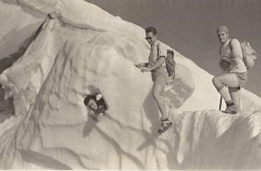
On Mt Hood’s Eliot Glacier: (R-L) Darr, Mount, and Calkin, 1930s. (Photograph courtesy of Gary Randall Photography.)

By then, this early spring of 1978, all that remained for Everett of climbing and skiing were remembrance and tall tales. Bone breaking falls and old age had made his joints arthritic, his walk a shuffle. Nothing, however,  had diminished his spirit.

Tough as an old boot is a cliché, but Darr was; he would give a man nothing that was not earned, neither wages nor respect. Some disliked his gruff manner; others accepted him as he was. Some thought his stories a bit too tall, but the man’s record speaks for itself.

Washington’s North Cascades saw Everett and wife, Ida, make numerous pioneering efforts on peaks that were, in the 1930s, all but inaccessible . Mt Hood, on the other hand, was in his backyard. Darr, with Jim Mount, put up a first ascent of what became the Wy’East Route on Mt Hood. In 1940,  he added another first ascent, this time of St Peter’s Dome in the Columbia River Gorge again with Ida, Joe Leuthold, and Jim Mount.

But those days were gone now. Only the memories endured.

Down in the basement of the Mountain Shop where the rental skis were kept, time passed slowly on rainy winter afternoons. Everett would always stop by and tell a tale. He never mentioned his triumphs, only the hard times. The grey skies reminded him of a night in the North Cascades after an attempt on Mt Goode. He and Leuthold were caught out by darkness, wind, and rain. They crouched in a tree well with nothing but the clothes on their backs. Leuthold rummaged in his pack. Extracted a bottle of whiskey. They drank to their two left feet and cowardly retreat.

Another day in early spring on Mt Hood: weather coming down with the darkness. He, Ida, and Joe, skiing this time out, came to a steep pitch laden with snow—it might have been Newton Clark glacier, or Eliot, or Coe. Everett did not always have the names quite right; but if all the facts were not straight, that was just too bad. The listener always knew he had been there, and usually before anybody else.

That steep pitch they faced had stopped them. Below, the crevasses had begun to gape open. A fall would be a dangerous occupation. They had traveled light, as usual, and a bivouac was not an option. Leuthold did have a length of rope. He offered a belay. Everett gallantly deferred to the lady. Ida roped up, poled off gingerly, turned slightly downhill for a bit of speed and just then a slab cracked and sloughed off beneath her. Down she went, flailing to stay on the surface of the slide.The rope went taut, and held. The avalanche rumbled off down the mountain. Everett hooted to salute his wife’s survival and skied quickly across the firm slide path.

One storm bound day in the basement of the shop—the snow had just slid off the roof three stories overhead and had effectively destroyed a Volkswagen parked too near the building—Everett leaned against the mounting bench and regaled me with an account of storm climbing. The middle of January had finally delivered some nasty weather. He and the usual suspects spent the night in the old Timberline cabin on the Palmer snowfield. By dawn they were off. Through wind driven snow they plugged up the snowfield.

Reaching what they determined to be the Triangular Moraine, a pow-wow was called. Conditions were, well, marginal. Wet and cold, they decided to climb on. Through the morning hours, the winds subsided, the snowfall became intermittent. Someone suggested they have some lunch and wait for the weather to worsen.

But up they went. As the day waned, the storm returned with a vengeance. Voices were lost in the wind and snow. They communicated with tugs of the rope. As Darr—or Calkins or Mount or Leuthold—crested the Hogsback, the wind tore at him. Up he went, a sack of bones and flesh in flight, picked up and tossed in a bundle down slope.

They huddled together. Great sport, they all agreed; but the day was gone, so down they went. Darkness had caught them, but it didn’t matter. They had not been able to see anything for hours anyway. Skill or luck or just plain orneriness saw them back to the cabin.

Looking north from Leuthold’s Couloir, photograph by the author, December 1981, with the Columbia River beneath the line of cloud and, in the background, Mt St Helens and Mt Adams.

One dismal spring day with rain and sleet, I waited as I heard Everett coming down the stairs, one step at a time. It took awhile. He stopped at the bottom of the stairs and looked around the corner into the shop. Outside, ravens commenced squawking.

“You got my hat?” Everett says to me.

“No, Everett,” I say. “I surely don’t.”

“Why not,” he snaps

I raise my eyebrows.

Everett shakes his head, puts on a sour face. He looked back up that long flight of stairs. He had remembered where his hat was.

Suddenly, he grinned, an elfish smile. “Damn steep stairs, ” he says. “How about roping me up? Awful steep. How about a belay?”

And then he turned, took a good hold on the rail, and up he went, one step at a time, up he went.

The Language Of Whales

Katharine Payne, a student of both music and biology during her undergraduate years, combined those interests to discover and document the songs of humpback whales. Since the late 1960s when this research began, these ‘songs’ have entered into the realm of common knowledge. This familiarity and a rather egocentric tendency that homo sapiens exhibit towards other species seems to have trivialized whale communication.

Whales have their own language. It is as simple as that. Humans are not unique in their ability to communicate. In fact, an argument can be made that human language, at best, is rather clumsy and inefficient. If one considers end results, all of human history and the current state of the planet provide all the facts anyone might need to make such an argument. The good that has been accomplished by our species seems to have been done by small groups of people working locally, people who have overcome the language barrier.

What evidence is there that whale sounds are no more than the equivalent of our grunts and groans? A discovery by Dr Payne made in 1969 is one piece of the puzzle. She found that whale songs change over time. As winter approaches, all the ‘singers’ in a particular breeding ground will start singing the previous winter’s song. By the end of their migration and the time spent at their feeding ground, these whales will be singing a new song, a very different song. And all the ‘singers’ in the population will have learned the new song. Obviously, something more complex than grunts and groans is going on here.

Katy Payne asserts that the humpbacks do more than just ‘talk’; they are using their language to compose and make their own brand of music.

The salient fact about all communication within and between species (except humans) is that of integration. Whales are one with their environment, perfectly adapted to all contingencies of life at sea; and the same might be said of aardvarks and zebras and everything in between. And though some humans speak disparagingly of nature red in tooth and claw, the relationships between species and with the environment generally is symbiotic. Are there malicious beasts in the jungle? Nasty brutes that prey on the weak simply from some perverse enjoyment of inflicting pain and suffering?

Only homo sapiens.

Our language seems, by design, to confuse and confront, to set us apart from one another and from the world around us. Of the three or four languages with which I am familiar, this conundrum is particularly true of English.

Music, however, does seem to be a different behavior all together. Perhaps the whales are on to something. Perhaps what we all need to do is talk a whole lot less and sing a whole lot more.