All men dream, but not equally. Those who dream by night in the dusty recesses of their minds, wake in the day to find that it was vanity: but the dreamers of the day are dangerous men, for they may act on their dreams with open eyes, to make them possible. T.E. Lawrence, The Seven Pillars Of Wisdom, 1922
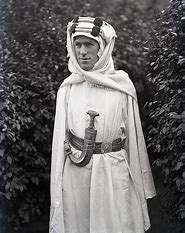
Thomas Edward Lawrence (1888 – 1935), the man with three first names, was relatively short and slight, just 5’5″ tall. During the first World War, he played a critical role in the Arab fight to dislodge the Turks from Arabia. Great Britain had a vested interest in the area due to their political stake in Egypt and the Suez Canal. They nominally supported the Arabian tribes; but often needed to be prodded to get something done. Lawrence, and a few others like him, through diplomacy and guile managed to get the British military to move in support of the tribes. They were also responsible for uniting the disparate factions and for laying down the overall plan for the various campaigns.
Three films have been made about T. E. Lawrence. The David Lean film of 1962 won an Academy Award for best picture. Peter O’Toole played Lawrence. The film romanticized the struggle in the desert, but is adequate for gaining an overall feel for the plight of the Arabs under Turkish rule. If more insight is wanted, Lawrence’s book, Revolt In The Desert, gives a clearer version of the story. Neither book nor film will be entirely accurate.
Memory is a fallible intellectual process.
A further problem is that Revolt is a condensed version of Lawrence’s larger work titled The Seven Pillars Of Wisdom. At 400,000 words, the book is rightly considered a substantial tome. The problem arises from the fact that Lawrence lost the original manuscript, left in a case on a train. Indefatigable as the man was, he promptly sat down at his desk and rewrote the entire book. Errors and omissions most likely resulted from the rewrite.
The film version of course is further removed from reality. Just one example of how this occurs can be found in the disparity between the heights of Lawrence and that of O’Toole: Lawrence was 5’5″ and O’Toole was 6’2″. There is also the dubious scene where a man is consumed by quick sand. This is simply a myth of Hollywood.
Media always embellishes and adapts to suit its needs.
The Beduin of the desert, born and grown up in it, had embraced with all his soul this nakedness too harsh for volunteers, for the reason, felt but inarticulate, that there he found himself indubitably free. T.E. Lawrence, The Seven Pillars Of Wisdom, 1922
Information on Revolt In The Desert and The Seven Pillars Of Wisdom can be found in BOOKS.
 majikwoid