EMPTY HEAD, OPEN HAND

Begin with a ubiquitous story of tea: The professor visited the master to test his understanding of zen. The Master offered tea. As the tea steeped, cups were placed. The professor went on explaining his visit, explaining zen, explaining Buddhism and its import in Japanese life. The master lifted the pot and leaned to pour tea for the professor. As the cup filled, the professor became quiet. As tea began to run over the table and onto the tatami, the professor could no longer contain himself. Stop, he cried. Stop, it’s full, it’s full. The master withdrew the pot, setting it carefully onto a trivet. Just so, he said. 
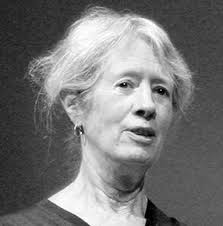
Lyn Hejinian (1941 – 2024)

The brain of a human contains 86 billion nerve cells. Unlike a tin pail filled with water, sensations, perceptions, conceptions will never ‘fill’ the brain. Consider the man, like the professor, who is full of himself. The metaphor describes a person who has an exaggerated notion of self worth. Egocentricity is his stock and trade.  

Empty headed is another metaphor used to indicate a person who does not think before he acts and so often behaves impulsively and mistakenly. The metaphor often suggests an unintelligent person, though behavior is not necessarily related to intelligence. 

Many 19th century psychologists subscribed to Sherlock Holmes’ notion that the brain was a vessel whose volume was finite so best not to clutter it with nonsense.  

The cup of tea suggests the metaphor rather than the physical fact; and the professor might be described as empty headed despite his discourse. 

The master might also smile at the notion described above of empty headed. He would no doubt say that an empty head is just the thing. One cannot add to a full head. The metaphor has morphed from an impulsive person who acts without thinking to an intuitive person who acts without thinking. 

Consider poetry. E. E. Cummings, perhaps, a good place to start, a poem titled Since feeling is First: 

since feeling is first both 

who pays any attention 

to the syntax of things 

will never wholly kiss you; 

wholly to be a fool 

while Spring is in the world 

my blood approves, 

and kisses are a better fate 

than wisdom 

lady i swear by all flowers. Don’t cry 

– the best gesture of my brain is less than 

your eyelids’ flutter which says 

we are for each other; then 

laugh, leaning back in my arms 

for life’s not a paragraph 

And death i think is no parenthesis 

This is not, obviously, a Shakespearian sonnet. This is: 

Shall I compare thee to a summer’s day?  

Thou art more lovely and more temperate.  

Rough winds do shake the darling buds of May,  

And summer’s lease hath all too short a date. 

Consider: The dog ate the car. Though syntax and grammar are correct, diction has led us astray. Though understandable, the words make no sense. The reader might even feel somewhat used: the brain reads ‘cat,’ does a double take and so reads ‘car.’ 

If we write: the dog eating the car left spilt milk on the kitchen stool pigeons flying overhead; and then change the shape of the line to: 

the dog eating the car 

left spilt milk on the 

tumbled stool 

pigeons flying overhead 

What results is jumbled syntax and an open ended poem (of sorts) that invites (or perhaps repels) the reader into the process rather than closing him or her, as the case may be, out (slam). 

Shakespeare’s sonnet does not invite comment about form or grammar or syntax or diction. One may reflect, but the poem is a closed book. 

Poet, essayist, and educator Lyn Hejinian became the leading figure of the Language poetry movement of the 1970s which supported experimental and avant-garde poetics. She became more concerned with the specific issue of openess in both language and life after the death of her daughter-in-law at a young age. She rejected the notion of closure and thought that inclusion and acceptance (the open hand) were imperative to facing both the travails of daily life and writing words. 

In her essay ‘The Rejection of Closure,’ she writes: The ‘open text’ is open to the world and particularly to the reader. It invites participation, rejects the authority of the writer over the reader and thus, by analogy, the authority implicit in other (social, economic, cultural) hierarchies.

The open hand and the empty head are not two things. 
THE OLD WAYS, A Remembrance of Everett Darr

Darr’s Mountain Shop was three stories high and  sided with rock. The gneiss blocks sat a bit proud of their mortar making for a good climb to change the light bulbs up under the eaves that illuminated Darr’s Mountain Shop. Everett Darr had been, in his day, a solid performer on rock, snow, and ice. He feigned disinterest or annoyance at my buildering solos, but there was a twinkle in the old man’s eye.

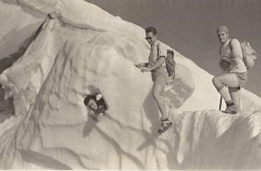
On Mt Hood’s Eliot Glacier: (R-L) Darr, Mount, and Calkin, 1930s. (Photograph courtesy of Gary Randall Photography.)

By then, this early spring of 1978, all that remained for Everett of climbing and skiing were remembrance and tall tales. Bone breaking falls and old age had made his joints arthritic, his walk a shuffle. Nothing, however,  had diminished his spirit.

Tough as an old boot is a cliché, but Darr was; he would give a man nothing that was not earned, neither wages nor respect. Some disliked his gruff manner; others accepted him as he was. Some thought his stories a bit too tall, but the man’s record speaks for itself.

Washington’s North Cascades saw Everett and wife, Ida, make numerous pioneering efforts on peaks that were, in the 1930s, all but inaccessible . Mt Hood, on the other hand, was in his backyard. Darr, with Jim Mount, put up a first ascent of what became the Wy’East Route on Mt Hood. In 1940,  he added another first ascent, this time of St Peter’s Dome in the Columbia River Gorge again with Ida, Joe Leuthold, and Jim Mount.

But those days were gone now. Only the memories endured.

Down in the basement of the Mountain Shop where the rental skis were kept, time passed slowly on rainy winter afternoons. Everett would always stop by and tell a tale. He never mentioned his triumphs, only the hard times. The grey skies reminded him of a night in the North Cascades after an attempt on Mt Goode. He and Leuthold were caught out by darkness, wind, and rain. They crouched in a tree well with nothing but the clothes on their backs. Leuthold rummaged in his pack. Extracted a bottle of whiskey. They drank to their two left feet and cowardly retreat.

Another day in early spring on Mt Hood: weather coming down with the darkness. He, Ida, and Joe, skiing this time out, came to a steep pitch laden with snow—it might have been Newton Clark glacier, or Eliot, or Coe. Everett did not always have the names quite right; but if all the facts were not straight, that was just too bad. The listener always knew he had been there, and usually before anybody else.

That steep pitch they faced had stopped them. Below, the crevasses had begun to gape open. A fall would be a dangerous occupation. They had traveled light, as usual, and a bivouac was not an option. Leuthold did have a length of rope. He offered a belay. Everett gallantly deferred to the lady. Ida roped up, poled off gingerly, turned slightly downhill for a bit of speed and just then a slab cracked and sloughed off beneath her. Down she went, flailing to stay on the surface of the slide.The rope went taut, and held. The avalanche rumbled off down the mountain. Everett hooted to salute his wife’s survival and skied quickly across the firm slide path.

One storm bound day in the basement of the shop—the snow had just slid off the roof three stories overhead and had effectively destroyed a Volkswagen parked too near the building—Everett leaned against the mounting bench and regaled me with an account of storm climbing. The middle of January had finally delivered some nasty weather. He and the usual suspects spent the night in the old Timberline cabin on the Palmer snowfield. By dawn they were off. Through wind driven snow they plugged up the snowfield.

Reaching what they determined to be the Triangular Moraine, a pow-wow was called. Conditions were, well, marginal. Wet and cold, they decided to climb on. Through the morning hours, the winds subsided, the snowfall became intermittent. Someone suggested they have some lunch and wait for the weather to worsen.

But up they went. As the day waned, the storm returned with a vengeance. Voices were lost in the wind and snow. They communicated with tugs of the rope. As Darr—or Calkins or Mount or Leuthold—crested the Hogsback, the wind tore at him. Up he went, a sack of bones and flesh in flight, picked up and tossed in a bundle down slope.

They huddled together. Great sport, they all agreed; but the day was gone, so down they went. Darkness had caught them, but it didn’t matter. They had not been able to see anything for hours anyway. Skill or luck or just plain orneriness saw them back to the cabin.

Looking north from Leuthold’s Couloir, photograph by the author, December 1981, with the Columbia River beneath the line of cloud and, in the background, Mt St Helens and Mt Adams.

One dismal spring day with rain and sleet, I waited as I heard Everett coming down the stairs, one step at a time. It took awhile. He stopped at the bottom of the stairs and looked around the corner into the shop. Outside, ravens commenced squawking.

“You got my hat?” Everett says to me.

“No, Everett,” I say. “I surely don’t.”

“Why not,” he snaps

I raise my eyebrows.

Everett shakes his head, puts on a sour face. He looked back up that long flight of stairs. He had remembered where his hat was.

Suddenly, he grinned, an elfish smile. “Damn steep stairs, ” he says. “How about roping me up? Awful steep. How about a belay?”

And then he turned, took a good hold on the rail, and up he went, one step at a time, up he went.

THE ANCIENT RIVER

The following is an excerpt from my book A BRIEF HISTORY OF THE COLUMBIA RIVER. The book is available at The Book Patch Bookstore and at Kobo eBooks.

WE STRUGGLE WITH numbers we cannot imagine. 100,000 people fill a football stadium and gives us some notion of this number; but a million years leaves a blank. Geology seems rife with such numbers. 4 billion years ago the planet came to be. 62 million years ago came the extinction of the dinosaurs. Several million years ago, with the exception of the Columbia River Gorge and the river that runs through that gorge, the Pacific Northwest looked much as it does today. Glaciers would come, and glaciers would go, covering and carving the landscape. Mountains were pushed up and ground down. Volcanic eruptions, rising and falling sea, wind and rain all added their signature.

Mouth of Columbia River Gorge. Mitch Williams’ photo.

Before the river there was lava. Before the mountains there was lava. 17 million years ago the  first eruptions were a series of immense lava floods flowing from great fissures near the present Oregon-Idaho-Washington border. Some of these flows, among the largest ever to occur on Earth, traveled as far as 400 miles from their eastern vents to Yaquina Bay on the central Oregon coast. Individual flows covered as much as 10,000 square miles, equivalent to one tenth of the state, and many are over 100 feet thick. Columbia River Basalt, exposed in many places through the gorge, often cooled to form the distinctive basaltic  columns that have become an iconic part of Oregon’s scenery.

Over millions of years, deposits of clay, sand, and gravel left by inland seas, lakes, and rivers were layered within the lava flows forming distinctive strata. Over time these deposits were compacted into soft rock, then lifted and tilted by tectonic forces. Mesas and mountains rose and were eroded away only to rise again, shaped into hills and buttes and mountain peaks by weather, wind, and water

Three to five million years ago came the evolution of the five salmon species known today. Fossils unearthed in ancient sediment show that giant sloths, porcupines, horses, and a host of other creatures great and small, existed.  And during this same time, an epoch that geologists label Pliocene, the river began to carve its path south and west to the sea.

Volcanoes, then, made the creation of the Columbia River possible. A geologist might quibble. Technically, the bulk of the lava flowed from linear fissures. Eruptions like Mt St Helens (1980), are fairly recent. Mt Hood last erupted in 1781. Even Mt Mazama is dated at just 30,000 years ago, an eye blink geologically. The lava floods were much older, and had a far greater impact. The lava, however generated, provided the ground and the parameters which determined the river’s path, its width, its depth.

By 3 million years ago, the river had begun its work carving a course through the recurring uplifts and volcanic outflows. A million years ago, the Columbia’s path was much like it is now. 20,000 years ago, the river had carved a deep V-shaped channel through the basalt flows, the sand and gravel, the mud and clay, cutting a course from the rolling Palouse of eastern Washington, across the arid uplands of eastern Oregon, through the Cascades, and on to the coast. The ancient river’s banks rose abruptly up to mesas in the east, then to the higher peaks through the Cascades; finally, as the river met the valley and slowed, it widened and gently flowed to its meeting with Pacific tides.

No evidence of a native people exists for this early period in the river’s history. Some archaeologists working with anthropologists think a date of 20,000 years ago is quite possible. The Pleistocene’s last ice age still held most of the northern half of the continent  in its grip, and the climate was 6 – 8 degrees colder. South of Puget Sound, however, the land was free of ice and did offer habitation and a bounty of fish, game, and plants.

If native people did inhabit the region 20,000 years ago, those living along the river were in for an unpleasant surprise. The gradual warming of the planet that ended the age of ice began 16,000 to 19,000 years ago. This warming caused the erosion of an ice dam in western Montana. That dam held back a body of water nearly the size of Lake Erie. The precipitous collapse of the ice and the sudden release of such a large body of water that inexorably followed created unimaginable floods.

A wall of water a thousand feet high moving at 50 miles an hour would have created an air blast heard a half hour down river. Chaos and catastrophe followed. Flood waters 400 feet deep inundated what is now Portland. The Willamette Valley was flooded as far south as Eugene. Little wonder that no evidence of inhabitation can be found along the river’s banks.

Named the Bretz Floods (or Missoula Floods or Spokane Floods) for Harlan Bretz, the geologist who first proposed the idea of cataclysmic flooding, the water once released from its impoundment followed the Columbia’s channel through the scablands of eastern Washington, the mountains of Oregon, and out into the Pacific transforming everything in its path. Flood waters scoured the excellent top soil of eastern Washington and deposited most of it west of the mountains, much of it down the Willamette Valley. The ancient V-shaped river valley was scooped and dredged by the rush of water, ice and stone; and the U-shaped gorge we see today resulted. This, too, was the river that Lewis and Clark saw.

Wallula Gap marked the turning point for the Bretz floods. Twin Sisters Rock, southeast of the gap, offers a sweeping view of the river and the narrow cut in the basalt plateau which provides the only outlet for the entire Columbia Basin of eastern Washington. The immense volume of water quickly filled this inadequate passage, and rose to cover the high hills to the east and south and Horse Heaven Hills to the northwest.  The flood waters, balked as they were, inundated the region as far north as Ephrata, over 100 miles away, with water deep enough to form the short-lived so-called Lewis Lake.

Twin Sisters Butte

From a book written in 1920 by L.R. Freeman comes this description of Wallula Gap and Twin Sisters:

A skyline of brown mountains, with a double-turreted butte as their most conspicuous feature, marks the point where the Columbia finally turns west for its assault on the Cascades and plunged to the Pacific. That bend is the boundary of the fertile plains extending from the Yakima to the Walla Walla, and the beginning of a new series of gorges, in some respects the grandest of all. The matchless panorama of the Cascade gorges is a fitting finale to the stupendous scenic pageant that has been staged all the way from the glacial sources of the Columbia.

The double-topped butte, an outstanding landmark for voyageurs for a hundred years, has long been called “The Two Virgins.” The story is told locally of a Catholic priest who saved his life by taking refuge in a cave between the castellated turrets during an Indian massacre, but who got in rather serious trouble with the Church afterwards as a consequence of sending words of his deliverance by a French-Canadian half-breed voyageur. The latter got the salient details of the story straight, but neglected to explain that the two virgins were mountains. The result was that the unlucky priest narrowly missed excommunication for saving his life at the expense of breaking his vows. I got no affidavit with the story, but local “stock” yarns are always worth preserving on account of their color.

A legend of the Cayuse tribe who lived in that area  tells a different tale of the butte’s creation. Coyote—the mythical reprobate of native lore—had become enamored with three  rather lovely sisters who chose to remain aloof. Unrequited, jealous, he turned one of these young women into a cave, and the other two into the prominent rocks on the Washington shore. 

The formation has been given many names over the years: Two Captains (for Lewis and Clark), Chimney Rocks, Hell’s Smokestacks, Cayuse Sisters, and the Twin Virgins.

The two pillars attest to the strength and fury of the Bretz Floods. Once part of the extensive Columbia Basin lava field, the flooding stripped away the looser sediment and left the Twin Sisters. As the waters subsided, the pillars emerged to become today’s prominent landmark.

SIMPLE ELEGANCE

Poetry is not everybody’s cup of tea. Nobel laureates Joseph Brodsky, Derek Walcott, and Seamus Heaney (friends, they were—ah, to be a fly on the wall when those three got together) suggest that literature in general and poetry in particular are the best tools for prying open the closed mind.

To acquire a taste for poetry is less difficult if the poems are neither lengthy nor too complex. Hamlet, despite Shakespeare’s reputation, might put one off. Many poems by Robert Frost might serve though it could be argued that he lacks elegance. 

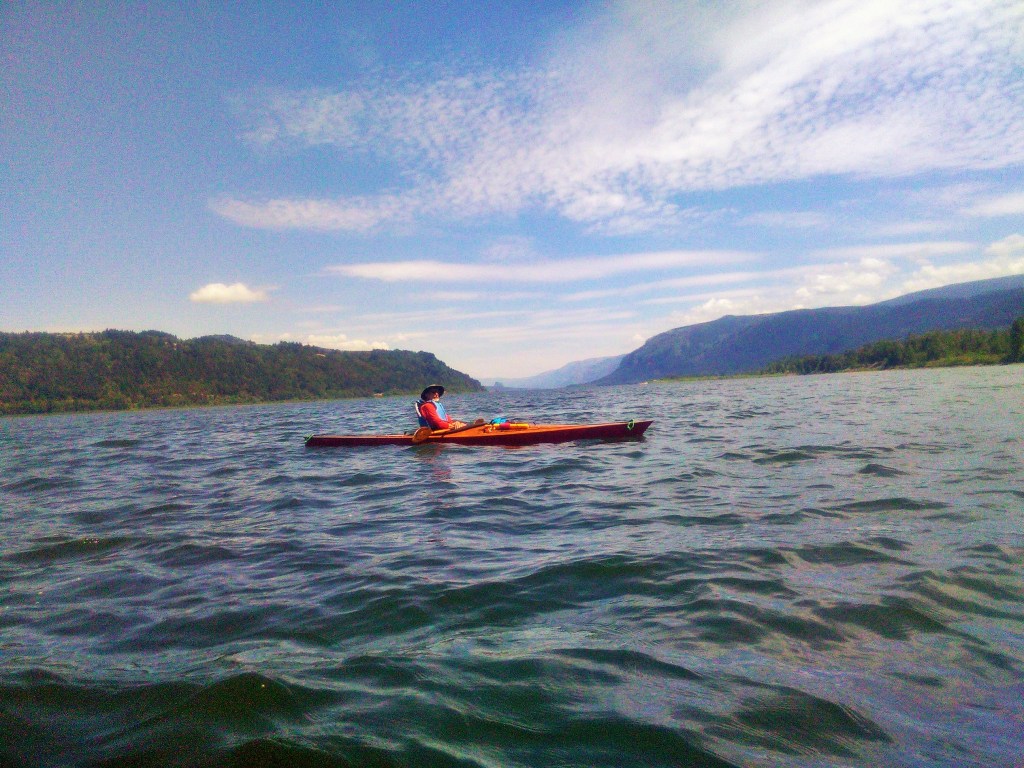
The cup pictured above is both simple and elegant. Many kayaks possess the same qualities. Classical guitars are relatively simple and certainly elegant. Simplicity is the quality of being plain or natural. Elegance, in this sense, is the quality of gracefulness and, perhaps, ingenuity.

Haiku are simple poems of seventeen Japanese syllables. With their origin some 800 years ago, they began as humorous and sometimes ribald forms of expression for Japanese wits much like the limerick in English. There was a young man from Boston who used to drive an Austin … That sort of business.

In the 17th century Matsuo Bashō changed all that. He was an inveterate traveler, walking many miles throughout Japan. His most famous composition is The Narrow Road To The Deep North. This book and his other travel journals were not only examinations of famous places in Japanese history, but also deep probes into his own psyche. His writing combined prose and poetry and both formal and informal themes.

Sleeping in a stall—fleas, lice, horse pissing nearby

Poems such as these are accessible and a good place to begin acquiring a taste for words so arranged. What elevated Bashō from both his contemporaries and his predecessors was his ability to select just the right word that captured a moment in his travels, but also offered insight and reflection. So, while his poetry may be an ideal place to begin, there seems to be no end to the consideration one might give to his words.

Breaking the silence of an ancient pond, a frog jumps into water—a deep resonance

Connoisseurs have spent lifetimes on those few words. The reason lies in the nature of the Japanese language. The initial suggestion was to begin with Japanese haiku. Even in translation, these poems offer more for the reader than do haiku in English or other languages. 

The penchant for rendering English haiku in three lines of five, seven, and five syllables is strictly an affectation. Bashō wrote his poems in one line that was either horizontal or vertical. Translations of Japanese haiku, older verses especially, are often given with the original kanji included. Kanji are the Chinese characters the Japanese adopted for their written language. This provides an opportunity for the reader to explore another dimension of the poems.

Kanji are simply picture words, miniature works of art. Anyone who enjoys jigsaw puzzles will have no problem deciphering kanji. A literal translation is not difficult to come by. Deciding on a more figurative rendering becomes something to ponder. Consider the title of Bashō’s most famous work:

Oku no Hosomichi

Pronunciation is straightforward. The vowels and consonant are much like Italian. Unlike English, there are no stressed syllables. The repetitive ‘o’ sound in the title is intentional; and this, of course, is lost in translation.

Nobuyuki Yuasa, whose rendering of the work has become a classic, suggests: Narrow Road to the Deep North

Others prefer Journey to the Interior. Literally, ‘oku’ means interior, ‘no’ gives to, and ‘hosomichi’ narrow road or path. The key point is contained in the word ‘oku.’ The notion of ‘interior,’ given the nature of Bashō’s intent, seems essential to any credible translation.

Nobuyuki is known for his figurative translations. Jane Reichhold, author of Bashō, The Complete Haiku, is more literal. Shades of meaning and depth of understanding are what are at stake.

Bashō’s so called ‘death poem,’ recited to his disciples, was translated by Reichold as:

ill on a journey

dreams in a withered field

wander around

My translation:

Sick on my journey,  dreams wander the withered  field

旅に病んで 夢は枯野を かけ
tabi ni yande/ yume wa kareno wo/ kakemeguru

The character above translates (see jisho.org) as ‘go around,’ ‘revolve’ and so becomes ‘wander.’ Japanese verbs, like German, come at the end of the sentence. Kakemeguru currently means ‘to rush about.’ For Bashō, in 1689, the word meant ‘to drift’ or ‘amble.’ Wander is sufficient and offers the alliteration with withered.

As Emerson suggested and others have seconded, art is all in the details. And once one is immersed in such minutiae as rhyme, alliteration, cutting words, season words, let alone meaning, one tends to leave one’s ego nestled quietly within the grey matter of one’s frontal lobe.

Information on Basho, The Complete Poems and The Narrow Road To The Deep North can be found in BOOKS.