PIGS ON ICE

William James wrote:

All action is a re-action upon the outer world. The current of life that runs in through our eyes and ears is meant to run  out at our hands, feet, or lips. The only use of the thoughts which it occasions while inside is to determine its direction to whichever of these organs shall, under the circumstances actually present, act in the way most propitious to our welfare.1 

How optimistic. ‘The only use of the thoughts …’ seems to have given ‘thoughts’ short shrift. Of course, the quote is out of context; and anyone who has read James knows he is never short on explication. Elsewhere I have argued that William’s ‘stream of consciousness’ is better described as scenes of a film badly edited, herky-jerky no less, and our subsequent actions, determined by thoughts, are akin to the antics of a pig on ice.

These actions of our hands, feet, and lips often lack the grace and agility or fluency that we would wish. Consider the man (or woman) late for the office. He gathers his keys, starts for the door, stops, considers the light on in the kitchen, turns, stops, turns back to the door, stops, drops his briefcase, goes halfway to the kitchen, utters a curse, stops, turns back to the briefcase, and out he goes, slamming the unfortunate door behind him.

The character in our little drama did not act in a way most propitious to his welfare.

A man I knew—quite an intelligent fellow, invented a better fence for table saws among other things, built and played classical guitar—once became infuriated by his inability to locate the TV guide. When at last he did find the errant guide, he nailed it to the wall above the television with a 16 penny nail.

In all fairness, James does go on to say:

Preferences [what we chose to do], the ends that we pursue, do not exist at all in the world of impressions we receive by way of our senses, but are set by our emotional and practical subjectivity altogether.

He goes on to posit our ‘fondnesses’ for considering moral values—this is good, this is bad; that is better, this worse—before we ultimately act with hand, or feet, or lips. But all these decisions need making, excepting of course ‘the hand in the fire’ type reflect action. And how do we decide? Our senses have provided us with data. Our brain has translated (some prefer  ‘filtered’ or other analogies), then considered options, then acted (to put it baldly). How many options need be considered? How many pros and cons get listed? When is enough enough? Then what? We decide.

Why is slapstick comedy inevitably funny? It is the human condition.

Climbing up Mt Hood’s Leuthold’s Couloir one cold winter’s day, a friend and I marveled at the firmness of the snow as we kicked the points of our crampons into the steepening slope. Overhead, clear crisp blue skies. Weather set. Until we topped out on a bench called the Queen’s Throne and discovered that a lenticular cloud had sneaked up behind us and we were about to be engulfed.

Swirling wind driving pellets of ice rendered eyes and ears rather useless. We stood on the summit, blind and deaf, with but a vague idea of our whereabouts. Two decisions were at hand. Which way down and who would lead. Down was anybody’s guess, but we had both been on Hood’s summit before and had skied below Crater Rock, the large plug in the summit crater’s cirque, many times. We thought the precipitous Steel Cliffs were to our right, and the standard route up the Hog’s Back was somewhere to our left.  After a round of rock, paper , scissors—which I won— I moved to my left ten yards or so to feel a little better about clearing the cliffs, then started down. I think we were roped. Often two climbers went unroped for if one fell they both fell with little or no recourse. This was the presumed fate of Mallory and Irvine on Everest in 1924.

As I stepped off I knew that if the slope before me was as hard as the couloir that we had climbed up, I was in for a ride. The gods were smiling as I plunged stepped down in knee deep wind drift. I managed to avoid the fumaroles and greeted the looming bulk of Crater Rock with raised axe.

The decision to step off (into the abyss? onto hard snow? ice? drift?) was made without ‘thinking,’ without ‘consideration.’ Under the conditions of swirling snow and ice, we both were operating instinctively, intuitively. The decision simply got made.

Stirling Moss, on everyone’s list of top Formula 1 drivers, has similar words to describe the decision he makes as he motors along at 120 miles per hour. Split second timing is needed to get the car exactly where it needs to be. He has no awareness of ‘making decisions.’ There simply is not time.

Moss’s physical equipment is demonstrably not normal. Like Joe Louis at his peak, when, he has said, he often found that he had hit a man before his brain had had time to note the opening, Moss has often braked, accelerated, or changed course before his brain could record the reason.2

Even when there is time to decide, to weigh the pros and cons, all considerations are merely foreplay. Ultimately we just decide. Obviously, if we are deciding who takes the garbage out we are talking about a different breed of dog.

Reducing a decision or an object or an abstract concept to constituent parts, I would argue, gives a false impression, and leads one to thinking, like James, in plurals which in turn fosters more decisions to be made, which leads to confusion and more difficulties than the original decision.

Reductionism is part and parcel of duality: Me and him, us and them, black and white, this and that. Western civilization is plagued with duality. We are bludgeoned with the notion at every turn. Schools teach it, religions insist on it, governments legislate it.

But the dancer and the dance are not two things.

Of course, James would label this business of decisions-just-happening some form of transcendentalism about which nothing can be known. Metaphysics does not lend itself to reduction because there are no parts. It is all or nothing. Or both. Or neither.

Did I hear William snort?

While it is true that metaphysics in general and enlightenment in particular cannot be described as one might describe something as abstract as a state of mind, the behavior of one who’s mindset if focused can be described.

John Jerome wrote a book on the subject titled The Sweet Spot In Time. Mainly about football and martial arts, the behavior experienced by himself, John Brodie, former quarterback for the San Francisco 49ers, and others has been experienced by any number of people in every walk of life.

One need not contemplate one’s navel for hours at a time. Merely do what you do. Carpenters, plumbers, readers, writers, firemen, farmers, perhaps even a politician or two have all experienced the feeling that what they were doing was ‘being done’ and time passed unnoticed. Musicians all know that nothing can be played or sung well if it requires thought or any other intellectualization. If you have to read the music, it is extremely difficult to play or sing well.

Inevitably, the dancer must become the dance; otherwise, one’s actions are merely awkward motions running out through are hands and feet and lips. Pigs on ice.

1 William James, The Will To Believe; Longmans, Green, and Company. New York, 1912. p114

2 Stirling Moss with Ken Purdy, All But My Life, Bantam Books, New York 1963. p26
SAGACITY

We are sitting on the rocks by the river waiting and watching as three ospreys circle overhead, hunting. The snow in the mountains has gone with the latest batch of hot weather; the river is low and, to our eyes, fish are scarce. What the ospreys see is, of course, something else again. Our vision is quite good. Some biologists think that our large brain became necessary to process all the perceptions our eyes (and other senses) take in, that our brain size has evolved more specifically with our visual acuity. Ospreys, apparently, can see twice as well as humans. However, that generalization does not tell the whole story: Osprey have the largest eyes relative to size of any animal; they have four color receptors to our three and can see ultraviolet light; their visual acuity due to a denser number of receptors is much better than ours; they can perceive the refractive index and so adjust their angle of vision to see beneath water’s surface; and ospreys can perceive magnetic fields to aid in navigation. Just how they process all this information  is unknown and, arguably, unknowable.

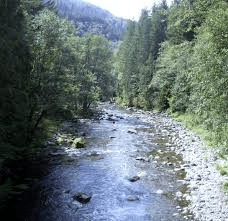
Salmon River near Mt Hood

Humans, according to a Caltech paper, think at a rate of 10 bits (binary digits) per second. However, our bodies’ sensory systems gather data about our environments at a rate of a billion bits per second, which is 100 million times faster than our thought processes. We are slow thinkers; and often cannot see the forest for the trees.

In 1890, concerning the notions of perception, conceptualization and, in turn, sagacity, William James wrote:

All our knowledge at first is vague. When we say that a thing is vague, we mean that it has no subdivisions ab intra , nor precise limitations ab extra ; but still all the forms of thought may apply to it. It may have unity, reality, externality, extent, and what not — thinghood , in a word, but [p. 344] thinghood only as a whole.  In this vague way, probably, does the room appear to the babe who first begins to be conscious of it as something other than his moving nurse. It has no subdivisions in his mind, unless, perhaps, the window is able to attract his separate notice. In this vague way, certainly, does every entirely new experience appear to the adult. A library, a museum, a machine-shop, are mere confused wholes to the uninstructed, but the machinist, the antiquary, and the bookworm perhaps hardly notice the whole at all, so eager are they to pounce upon the details. Familiarity has in them bred discrimination. Such vague terms as ‘grass,’ ‘mould,’ and ‘meat’ do not exist for the botanist or the anatomist. They know too much about grasses, moulds, and muscles. A certain person said to Charles Kingsley, who was showing him the dissection of a caterpillar, with its exquisite viscera, “Why, thought it was nothing but skin and squash!” A layman present at a shipwreck, a battle, or a fire is helpless. Discrimination has been so little awakened in him by experience that his consciousness leaves no single point of the complex situation accented aud [sic] standing out for him to begin to act upon. But the sailor, the fireman, and the general know directly at what corner to take up the business. They ‘see into the situation –that is, they analyze it — with their first glance. It is full of delicately differenced ingredients which their education has little by little brought to their consciousness, but of which the novice gains no clear idea.

He, of course, had a good deal more to say, as he always did, but that should suffice. He did put humans at the top of the list for sagacity. Brutes occupied the lower reaches. I beg to differ. I suggest that our vaunted ability to think and reason and speak is less a blessing and more a curse. The current state of the planet makes, I think, a good argument for this position.

Homo sapiens? Guess again.

If James’ opinion of ‘brutes’ is flawed, questions arise: Just how perceptive are brutes? And what exactly did he have in mind with that word? Whales perhaps? Or wolves? Or ravens; and how well do they communicate? how well are they integrated into their environments? Amphibians have existed for over 300 million years. Clever little devils. And just how intelligent might an osprey be? Are they, too, slow thinkers? Their hunts are successful only 25% of the time. Does this suggest a sluggish intellect? If pushed to an opinion, I would guess that all wild creatures perceive and process more efficiently than do humans. No living organism that I know of is at odds with its environment except human beings. The wonder might be that ospreys (and other wild creatures) survive as well as they do.

The birds seemed to have called it a day or merely have left the Salmon River for the nearby Sandy River. The Sandy is a bigger affair with more opportunities for a meal. All they need is several small fish or one larger one and they are replete (400 grams, it is thought). Perhaps the heat has sent them back to the nest. Are birds affected by heat? Birds are warm blooded and can regulate heat, so perhaps they have gone off to sit on a high limb in the shade. Whatever the case, even though they don’t stay long. It is always nice of them to drop by.

The sky is made a better place for the clear, sharp whistle calls of the fish hawks.

The temperature has reached 91° in the shade and it is not yet noon. Though the birds have abandoned the hunt, I am loath to leave the river. The wife has gone on to the post office and I’ll wait for her return. A dipper flits past, lands on a rock downstream and dives for a morsel. Of course, it may just be taking a quick dip to cool down. Robins, thrushes, jays all do the same. Our ponds are popular for bathing as well as drinking. Birds do seem to pant, but it is a different operation than how a dog pants. Birds can flutter their throat and cool in this manner.

I have worked up a sweat walking the quarter mile back to the house. No mail today. The wife has left me to check on a friend. Coming up our driveway, I take in the house. Two sides of the house are painted; the rest will have to wait for a break in the weather. Paint was drying on the brush faster than it could be applied. My wife, ever persistent, worked through two mornings and one early afternoon to get half the job done. 

I am concentrating on sanding and restaining our decks. The sanding does not begin until 9 AM out of consideration for the neighbors (and the hope that they will reciprocate). A two hour window in the morning cool has got me a quarter of the way through the job. Sitting by the river seemed a better occupation this morning, so I let the decks be.

A tomato and onion sandwich with a dab of Dijon mustard filled my belly, and a glass of ice tea and orange juice quenched my thirst. During lunch I listened to a few songs from Watchhouse and reflected on an interview with Emily Frantz and Andrew Marlin that I had seen recently. Our perceptions always affect us  on some personal level. Often we bite our tongues rather than speak and expose ourselves. Andrew, one of the best singer songwriters on the planet, was concerned about the rather personal nature of many of the songs on their new album. Then it occurred to him that everyone hears the song differently, and everyone makes it personal for themselves. The more empathy involved the closer one might come to someone else’s personal insights and emotions. But they then become our own, and the songs more often expose the listener’s emotions rather than the singer’s.

Many ‘brutes’ affect us the same way as do songs. Dogs and horses both have strong affinities with humans. Can we empathize with other critters? Those who work with animals would no doubt answer in the affirmative. Jane Goodall, for example, must have had some feeling and understanding for her apes. And Roger Payne must have felt privileged listening to and interacting with his whales.

Our friends know that they are welcome to drop by anytime, and many do. Most think there is a certain magic about our little piece of ground. We think it is simply a spirit of inclusion that we bring to the place. Spiders, newts, snakes, squirrels, ravens, skinks, raccoons, the odd black bear and the occasional osprey are all welcome. More directly, my wife and I have shared the place with over a dozen canine friends, mostly collies. An assorted group of cats also have roamed the place. And, not least in importance, we are surrounded by firs and cedars, a few hemlocks, some maples, cottonwoods and alders.

Brute has come to mean a savage and violent person or animal. For James in the 19th century, the word was more simply defined as an animal as opposed to a human being, an animal specifically lacking in intelligence. If we removed our opposition, we might all be considered brutes. When all is done and dusted, we are all animals, all part of the natural world, all interdependent.

Familiarity will breed discrimination, not for segregating, but for understanding; and with understanding comes both empathy and, most importantly, inclusion.

Thoth Hermes Trismegistus was, for the Egyptians, the god of wisdom, letters, and time. He had the body of a man and head of an ibis.

William James, Principles of Psychology, Vol. II; Dover Publications, New York.1890, p343.

THE COAST ROAD

Between Pacific City on the Oregon coast and the Cape Meares lighthouse to the north is a narrow two lane blacktop road that serves both the locals and the tourists—the dairymen and the fishermen, the hiker and the bicyclist—by providing access to land and sea. At the same time, the road serves by giving definition to the land, a physical definition through its function as a line that takes the measure of the terrain as the lines on a contour map do, now rising, now falling, here looping, there straightening; and a transcendental definition through its function as a poetical metaphor that takes the measure of this geography as a poem takes the measure of an idea or theme.

The poem uses the collision of words, the separation of phrases, to express itself. The road finds its expression in the brown cows ruminating cud, in the rusted jetsam that once was truck, in the solitary chimney standing sentinel over the blackened rubble that once was house, in the red barn, the sand dunes and mats of salal, the towns of ramshackle and renovated that punctuate the road, in the estates of chime and glass, cottages with frayed lace curtains and unkempt lawns, the bright green rectangle of new laid turf, the stumps and deadfall littering clear-cut hillsides, the mongrel yapping at the end of its chain, a rock slide, a bent and twisted guardrail, the missing sign, the rock and sand, and, finally, in the lighthouse, barely visible through the evergreens, a revolving blip of light out on some final point of land that measures the waves steady thump and rumble.

There is something elusive about this stretch of pavement, an ambiguity, a question hovering like the fog that is so ever-present hereabouts. There is meaning beyond the sum of its parts, beyond form and meter, beyond linguistics, beyond theme. So, too, do the many parts of the road scene, all the constituents along this strip, seem to speak more eloquently when conjoined than when examined individually. And, just as a poem only finds its voice after assembly, so it is along the road. There comes a grace to the man slopping his sow against the backdrop of the distant headland, a heroism to the lone chimney lost in the expanse of field and dune, a tender emotion, a moving presence, to that archetypal American family—mother, father, brother, sister—in matching shirts and shorts with their station wagon and dog down for a day at the beach.

Meaning is often incommunicable, beneath the surface, defying elucidation. Words hint at meaning; but often meaning can only be experienced. Abstraction is elusive; substance is not. The traveler suspects some hidden meaning lurking beneath the surface value of asphalt, house, widow, business, land form, grocer, seascape, and lighthouse, feels a need for explication. But unless he pauses in his travels, suspends his journey and noses about turning stones, that suspicion will rise on a sea breeze and be gone, the traveler none the poorer, but none the wiser either.

Pause, suspension, waiting, sitting quietly are keys to scanning this road. Everyone hereabouts lives in three-quarter time, and this waltz tempo helps define the area. By contrast, Highway 101, running a few miles inland, is an upbeat four-four proposition. Travelers propelled along by destination, by assignation, would not likely choose the coast road for their journey. The hard traffic stays on the 101. It is the quick link between Lincoln City and Tillamook. Cape Meares, Oceanside, Netarts, Cape Lookout, Sand City, Tierra del Mar, Kiwanda, and Pacific City are out-of-the-way places. Log trucks will vie for space on the 101; large, loud, and aggressive, they are no bargain. The odd truck plying the coast road gives some ground, like as not, perhaps a wave of the hand, not smiling, not friendly mind you, but not contentious either.

Businessmen on the 101 push their machines with abandon. The retiree in his motor home, seeking some refuge for the refuge he is driving, seeking some glimpse of the Pacific, some sound of the gulls, will be found pulled off in a turnout, nose to map, perplexed, dismayed. He is on the 101, after all, with little quarter given.

The coast road is the other road the retiree seeks where stopping on a whim becomes the attractive alternative, and experience finds opportunity to wander from the objective to the subjective, from destination to journey, from denotation to connotation, from white line of highway to white line of breakers.

Along this coast road the traveler is rarely far from the pounding surf. It is not a place to be in a rush; there is time here, but not seconds and minutes nor even hours. There is morning, afternoon, evening, and night. There are weeks and months and years. See it in the ramshackle building, some collection of homespun architecture nailed together over decades, the pumps still out front marking it as a gas station of a by-gone era. Out back are the odds and ends of automobiles, disarrayed like children’s toys after a morning’s play, hoods askew, wheels and doors gone, windshields shattered.

Attached to the building’s flank, a rusted metal stack pokes above the roof line and smoke curls gently up and away. The door dings open, the traveler waiting at the pumps. Out ambles a boy with a ball cap pushed back on his head, dungarees oil stained, the suit short-legged, hand-me-downs, his hands stuffed deep into his pockets. Has he just wakened?

The traveler asks for gas and for the distance yet to Pacific City. The boy, imitating the father who is from Kansas, says, “Three mile.” He spits, like the father, then turns slowly away to the sound of an old dump truck rapping in deceleration down the hill, hauling gravel.

Boy and driver exchange nods, pumps gas absently. The tank full, the boy milks the pump, adding pennies, then done. “Eight dollar fifty cent,” says the boy to the traveler. The look might be called vacant, but his youth keeps it just this side of blank, an imitation again of the father whose eyes are long absent, doing the same thing over and over again, eking out a living here on the coast road, a fair life, the father says, quiet like, can’t complain none, wife’d like the city some, spitting, pumping gas, telling the tourists time and again, three mile, knowing that soon enough those city people on their fancy bicycles will start coming through, never buying nothing, bottle of water maybe, or them Powerbars he’d been stocking, just wanting to use the can, telling them, nope, broke, which it ain’t but he just don’t cotton to giving things away.

This is the rhythm, the pace of life, on the coast road. If there is a rush, a hurry, best turn right at the junction and head her over to the 101.

All the varied entities that the traveler meets along the way—the beach cottages, the dilapidated sheds, a pair of horses standing head to tail, a grain elevator, hay ricks, sties, skunk cabbage, creek, the gathering wave—constitute the words and phrases of the road. The bay collides with the headland and a gentle mist rises. The rhymes here are less aural than visual: The martin winging against the pale dawn sky gives flight to black and white cows scratching at fence posts; an old man profiled at the end of the jetty fishing is mirrored by the snag hanging leafless over a swift creek.

Equally varied are the themes, the motifs, of the coast road. Central to the road, both physically and metaphorically, are the sand dunes that lie between the Kiwanda headland and Cape Lookout. All along the road through these dunes are signs warning of the soil stabilization project, prohibiting motor vehicles. The loops and swirls, the tread marks across the flats and through gullies give testimony to the effectiveness of the deterrent.

The traveler feels a tension here. This is the arena where the road’s two protagonists, man and nature, do battle. A State Park ranger, who officiates at the fray, occupies the foreground as the traveler approaches. The ranger nods curtly, then turns away from the traveler to continue his note taking, keeping score.

The sand, covering many square miles, is a most fragile environment. Though only the two lanes of blacktop cut it, the advantage in the short-term seems clearly with man. Thinly treed, matted with salal and grass, the dunes provide habitat and forage for rabbit and frog and snake, hoppers and sliders. Here man plods across the soft ground, trips in the tangled weed, starts at the sudden leap of gray-green, black-eyed frog. Overhead a red-tail hawk circles, hunting. A moth the color of weathered cedar ignores the curse of the man and floats and dips and flutters.

Resentful at his immobility, man brings his machines, though clearly this is no place for motor and wheels. This is a wild land, as-it-was land, save for the signs and the two lane blacktop bisecting. Man comes with his machines, becomes the ultimate predator, preying on the land itself. The ensuing destruction is rapid and all encompassing; but here, unlike the hillside on which the devastating effect of clear-cutting is readily apparent, it is difficult to see man’s impact.

“It’s just sand for Christ sake,” says the ATV enthusiast.

Only the geologist, the biologist, the botanist, the entomologist can truly take its measure. And then post signs. All the same, a frog meeting with an all-terrain vehicle faces the same odds as does the bicyclist who strays into the path of a log truck out on the 101.

At the end of this particular stretch of pavement comes, finally, the lighthouse. This seafarer’s beacon warns of the treachery of rock and tide, illuminating darkness, piercing fog. It was not supposed to be on this point of land; it was supposed to have been built on Cape Lookout, some miles to the south. All the building material, however, got delivered to the Cape Meares site; and, with no coast road here in 1890, with access so difficult, so dangerous, the lighthouse rose where the materials dictated, the harsh terrain having the final say.

That seems fitting, thinks the traveler, watching the light go round. Man proposes; the earth disposes. Not in the short-term, of course; for in time even this lighthouse will be gone. For the moment, the beacon seems an appropriate response to the question raised by the coast road. Here is the best of 19th century engineering wedded to the land, functional, beautiful. This marriage of science and humanity provides the elusive quality that rises like the fog all along this stretch of pavement, this sinuous man-made track through nature’s glories. Like an alchemist’s dream, there is a balance, a blending of the ingredients that defies addition. Here the metaphor of the coast road manifests itself.

The traveler trains his eye on the far horizon: The endless sea. The light goes round. Seagulls cry. Chilled by the stiff breeze, the traveler steps through the door at the base of the lighthouse and begins his upward spiral.

TROUBLE IN MIND

… gonna lay my head on some cold railroad line, let the 2:19 pacify my mind …

Murders have existed since Cain slew Abel, and stories about murders have always attracted eager ears. When stories become songs, ballads result; and a substantial portion of all ballads involve murders. From infanticide to genocide, all variations of man’s inhumanity to man are included; from Scandanavian eddas to African myths, every culture has its demons and demigods.

Most American ballads originated in Ireland, Scotland, or England and were brought to the United States by emigres. They all tell tales of misadventure. The word ‘ballad’ derives from the root word ‘ball’ which is found in both Latin and Greek forms to mean ‘dance.’ (Another form of ‘ball’ gives a spherical object.) The pronunciation of ‘ballad’ and the vagaries of early English spelling created a variety of terms that all came to mean a song sung to tell a story. 

Before printing, events of the day were orally reported by the town crier. The more conspicuous of these events became repeated and memorized. After the advent of printing—1440 in Germany—the events of the day were printed on broadsheets and posted. Music became integral to the process both to entertain and to aid memory, and melodies joined with lyrics which enhanced the telling. The songs that resulted were inevitably accompanied by simple instruments such as flutes, drums, banjos, and guitars.

With the advent of printing, the presses began churning out broadsheets, and the ballad was then posted on bulletin boards, doors, walls, and windows. The word ‘ballad,’ also spelled ‘ballet,’ may have gained additional meaning from its alliterative association with ‘bulletin.’ The songs were the headline news of the day, and like headline news stories, most died as soon as they were sung. But the more popular songs were passed on, reinterpreted, and eventually changed to suit some new occurrence.

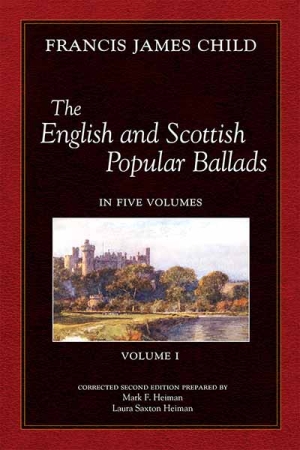
The composers of old ballads, for the most part, remain unknown. In 1860, Francis Child published an eight volume work that included 305 ballads.The melodies and themes have been used time again to create new songs or to give a new slant to the old work. Jealous husbands, unfaithful wives, deceitful lovers taking gun or knife in hand to resolve the unrequited relationship, hard driving boss men, hard hearted bank men, slave drivers, prison wardens, and whip wielding plantation owners all can be found in the stories told by ballads.

Humans have a predilection for gruesome events. From ‘Hunt-A-Killer’ website comes this:

… thousands would flock to these public executions [hangings], and the mood would usually be jovial. With people rushing to get a good spot close to the gallows, these public spectacles were known irreverently as the “hanging fair”, “stretching”, or “collar day.” The events held a carnival-like atmosphere.

Murder ballads from the British isles (Celtic traditions) and their American variants most often find men killing their wives and lovers (‘Tom Dooley,’  ‘Banks of the Ohio,’ and ‘John Lewis.’) Blues, originating in the southeast United States, began as the work songs of slaves, but by the early 20th century, the themes had become centered around women killing (or rejecting) their men (‘Send Me To The ‘Lectric Chair,’ ‘Silver Dagger,’ and ‘Frankie and Johnny’), with the men succumbing to a variety of vices that usually involved drinking, gambling, and fighting.

‘Lily of the West’ provides an example of a murder ballad that became a love song. Originally an Irish ballad, the song tells the tale of a man enchanted by Lily (or Flora or Molly-O depending on the version.) She had other ideas, however, and her new lover paid the price. He was knifed by her jealous suitor. Mark Knopfler, of Dire Straits fame, joined with The Chieftains to record an Irish version of the song. After its arrival in America, ‘Lily of the West’ soon became a standard. A few of the lyrics were changed, ‘Ireland’ replaced with ‘Louisville,’ and the murder, in the American version, often became a matter of self-defense.

As often happened, the same popular melody was used to tell a much different story. ‘Lily Of The West’ became ‘The Lakes of Pontchartrain,’ songwriter unknown but thought to have been written sometime after the civil war. A common practice of all song writers was this business of appropriating melodies, which cannot be copyrighted, and then adding their own lyrics. Bob Dylan, in his early days, did this repeatedly.

The murder ballad (infanticide and a hanging) ‘Mary Hamilton’ might be as old as the 14th century, but the 16th is more likely. While not a story with specific  historical precedent, many disparate incidents from various reigns (Russian, French, Scottish, and English) conjoin to make up the song’s lyric.

The king or tsar or prince has his way with one of the queen’s maids, she becomes pregnant, kills the baby by casting it out to sea, and is hanged in due course. Originally known as ‘The Fower Maries,’ dozens of versions have been recorded, the most compelling may be that of Joan Baez on her eponymous debut album of 1960. 

Dylan, feeding off the success of the Baez song, ‘borrowed’ the melody and wrote ‘The Lonesome Death of Hattie Carroll’ in 1963. The lyrics tell the story of the murder of Carroll by a wealthy young man named William Zantzinger. Dylan and Columbia Records were threatened with a lawsuit by Zantzinger, but the suit came to nothing. A video available on the internet is that of 22 year old Dylan performing the song after an awkward interview with host Steve Allen.

The folk movement of the 1960s began with the success of the Kingston Trio. These clean cut college boys with the button down shirts recorded ‘Tom Dooley’ in three part harmony, simple instrumentation, and a memorable refrain. While not as topical as Dylan’s account of the murder of Hattie Carroll, Tom Dooley ( or Dula, a Confederate soldier) tells the story of the 1866 murder of Laurie Foster and the subsequent hanging of Dooley. The song went, in short order, to number one on the charts; and folk songs, fusing with blues and rock, became the most popular music genre of that decade.

Historically, most ballads and early blues were performed by single performers with cheap battered instruments. The early balladeers, like modern day buskers, would station themselves on some conspicuous street corner and sing the news. Blues men sang on porches, in town squares, and, when they could get the gigs, in juke joints, smoky dim lit rooms often heated by a barrel burning wood. Inevitably, they would sit on straight backed chairs, sing their songs (often quite a variety) and drink their whiskey. Video of an old blues man named Sam Chatmon (1899 – 1983)  provides an example. Chatmon, who played with the Mississippi Sheiks in the 1930s, was 79 years old when the video linked below was recorded by Alan Lomax, John Bishop, and Worth Long at Chatmon’s house in Hollandale, Mississippi.