Jacques Brel (1929 – 1978) wrote hundreds of songs during a long career that spanned four decades. He sang them with gusto. His lyrics, he claimed, were impossible to imagine ‘ … without the sound of music intruding.” Born in Belgium, he is revered in France; yet remains relatively unknown in the United States. His disgust with American belligerence in Viet Nam kept him from touring here.
The lyrics from his song ‘The Bulls’ are posted below; and a link is provided to listen to the song as performed by Shawn Elliot and Company. The Company is Mort Shuman, Elly Stone, and Alice Whitfield. Shuman was a friend of Brel, and it is his production of Jacques Brel Is Alive And Well And Living In Paris that contains the best translations and covers of Brel’s work.
In April of 1945 with the second world war ending, Benito Mussolini, the tyrant of fascist Italy, made a run for the Swiss border. He came up short. Captured near Lake Como, he and his mistress, Claretta Petacci, were caught and machine gunned to death the following afternoon. For the partisans of northern Italy, justice done. The bodies of Mussolini and Petacchi were then taken back down the mountain to Milan where they were hung by the heels from a girder of an Esso gasoline station so that the people might vent their spleen.
On the other hand …
A mendicant monk named Ryokan lived a life of simplicity in a little hut at the foot of a mountain. One evening, while he was away, a thief sneaked into his hut only to discover thatRyokan had nothing worth stealing.
As the thief stood scratching his head, Ryokan returned and found him. “You’ve come a long way to visit me,” he told the prowler,“and you should not return empty-handed.Please take my hat, and this jacket as gifts.”
The thief was suspicious and bewildered, but he took the hat and jacket and backed out of the hut. “Ah, but wait, Ryokan said. From his bundle he pulled a battered wooden bowl. Have this, too, he said. The thief, fearing this fellow was a tengu, a mountain devil, yelped and off he ran.
Ryokan sighed. He went out behind the hut and sat in his loin cloth on a flat stone, gazing up at the night sky.“Poor fellow,” he mused,“ I wish I could have given him this beautiful moon.”
from One Robe, One Bowl The Zen Poetry Of Ryokan. See synopsis in BOOKS.
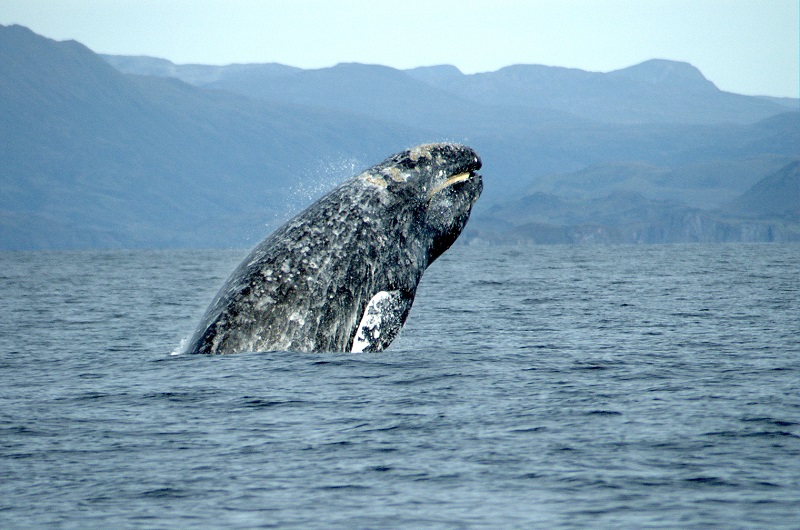
Katharine Payne, a student of both music and biology during her undergraduate years, combined those interests to discover and document the songs of humpback whales. Since the late 1960s when this research began, these ‘songs’ have entered into the realm of common knowledge. This familiarity and a rather egocentric tendency that homo sapiens exhibit towards other species seems to have trivialized whale communication.
Whales have their own language. It is as simple as that. Humans are not unique in their ability to communicate. In fact, an argument can be made that human language, at best, is rather clumsy and inefficient. If one considers end results, all of human history and the current state of the planet provide all the facts anyone might need to make such an argument. The good that has been accomplished by our species seems to have been done by small groups of people working locally, people who have overcome the language barrier.
What evidence is there that whale sounds are no more than the equivalent of our grunts and groans? A discovery by Dr Payne made in 1969 is one piece of the puzzle. She found that whale songs change over time. As winter approaches, all the ‘singers’ in a particular breeding ground will start singing the previous winter’s song. By the end of their migration and the time spent at their feeding ground, these whales will be singing a new song, a very different song. And all the ‘singers’ in the population will have learned the new song. Obviously, something more complex than grunts and groans is going on here.
Katy Payne asserts that the humpbacks do more than just ‘talk’; they are using their language to compose and make their own brand of music.
The salient fact about all communication within and between species (except humans) is that of integration. Whales are one with their environment, perfectly adapted to all contingencies of life at sea; and the same might be said of aardvarks and zebras and everything in between. And though some humans speak disparagingly of nature red in tooth and claw, the relationships between species and with the environment generally is symbiotic. Are there malicious beasts in the jungle? Nasty brutes that prey on the weak simply from some perverse enjoyment of inflicting pain and suffering?
Only homo sapiens.
Our language seems, by design, to confuse and confront, to set us apart from one another and from the world around us. Of the three or four languages with which I am familiar, this conundrum is particularly true of English.
Music, however, does seem to be a different behavior all together. Perhaps the whales are on to something. Perhaps what we all need to do is talk a whole lot less and sing a whole lot more.
The river begins on the slopes of Olallie Butte at 6000′ and meanders some 80 miles from the west slope of Oregon’s Cascade Range through canyons and bluffs to the once forested rolling plains of the Willamette Valley until it debouches into the Willamette River just below the falls at Oregon City, elevation 12 feet.



 majikwoid